
How to Search Lake County Court Records
The main public case search for Lake County is the Clerk's ShowCase portal at courtrecords.lakecountyclerk.org. The portal pulls live data from the Lake County Clerk of the Circuit Court and Comptroller case-management system. It covers civil, criminal, traffic, family, probate, and most other case types. The official front door is the Clerk's Search Online Court Records gateway, which posts notices about image limits, redaction, and access rules before the link to the search opens.
Before you start, gather what you have. A full name helps. A case number is faster. Spelling can vary, so try SoundEx or Starts With when the spelling is unclear. The Clerk says cases before 2003 generally have no document images. Criminal traffic has no images before 2009. Civil traffic has no images before 2013. Some files may be sealed or partly redacted.
- Open the official Clerk gateway and read the access notices.
- Click Accept and Search Court Records to launch ShowCase.
- Enter a case number such as 35-2026-CF-000553-AXXX-01, or type a last name and first name.
- Pick a Court Type and Status if you want to narrow results, such as Felony or Misdemeanor.
- Select a Search Type. Use Exact for a known spelling. Use SoundEx for sound-alike names. Use Starts With when you are unsure.
- Review the result row for case number, party type, file date, fee balance, and any open-warrant flag.
- Open a case to view parties, charges, docket entries, court events, and image indicators.
- Request a certified copy from the Clerk if you need a stamped, court-issued record.
You can find the official civil division behind the Clerk's Civil Division page. The image below shows the page used to launch civil filings and look up case-management contacts.
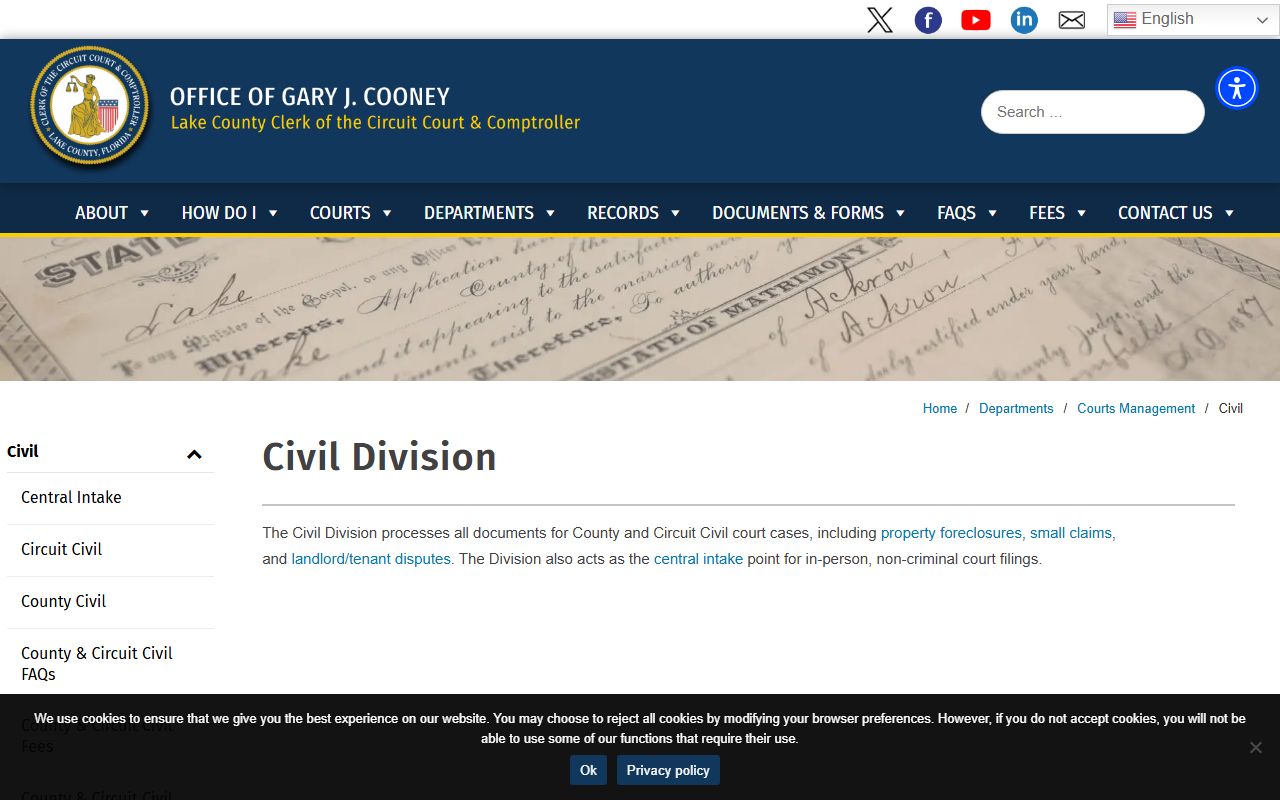
The civil division page links out to county civil, circuit civil, small claims, and landlord-tenant resources. It is a useful map for figuring out which sub-division will hear a Lake County lawsuit before searching case records.
The Lake County Judicial System
Florida's court system has four levels. The Florida Supreme Court sits at the top. Five District Courts of Appeal sit below that. Lake County is served by the Fifth District Court of Appeal. Below the appellate level, trial work is split between Circuit Courts and County Courts. Lake County's circuit is the Fifth Judicial Circuit, which also serves Citrus, Hernando, Marion, and Sumter Counties. Probate is a division of the Circuit Court, not a separate court. The Clerk is unified, so a single office handles both circuit and county case files.
The Fifth Judicial Circuit assigns judges to the Lake County courthouse for circuit and county dockets. The Lake County Elections Judicial page lists circuit judges in groups, including James R. Baxley as Administrative Judge. County court judges include Emily Curington, Sarah J. Jones, Carla R. Pepperman, and Chad J. Monty. Each judge handles assigned divisions such as criminal, civil, family, or traffic. The ShowCase Judge field in the portal lets you filter searches by judge when needed.
Jurors called for Lake County duty get their own portal at juryweb.lakecountyclerkfl.gov. A screenshot of that login is below.
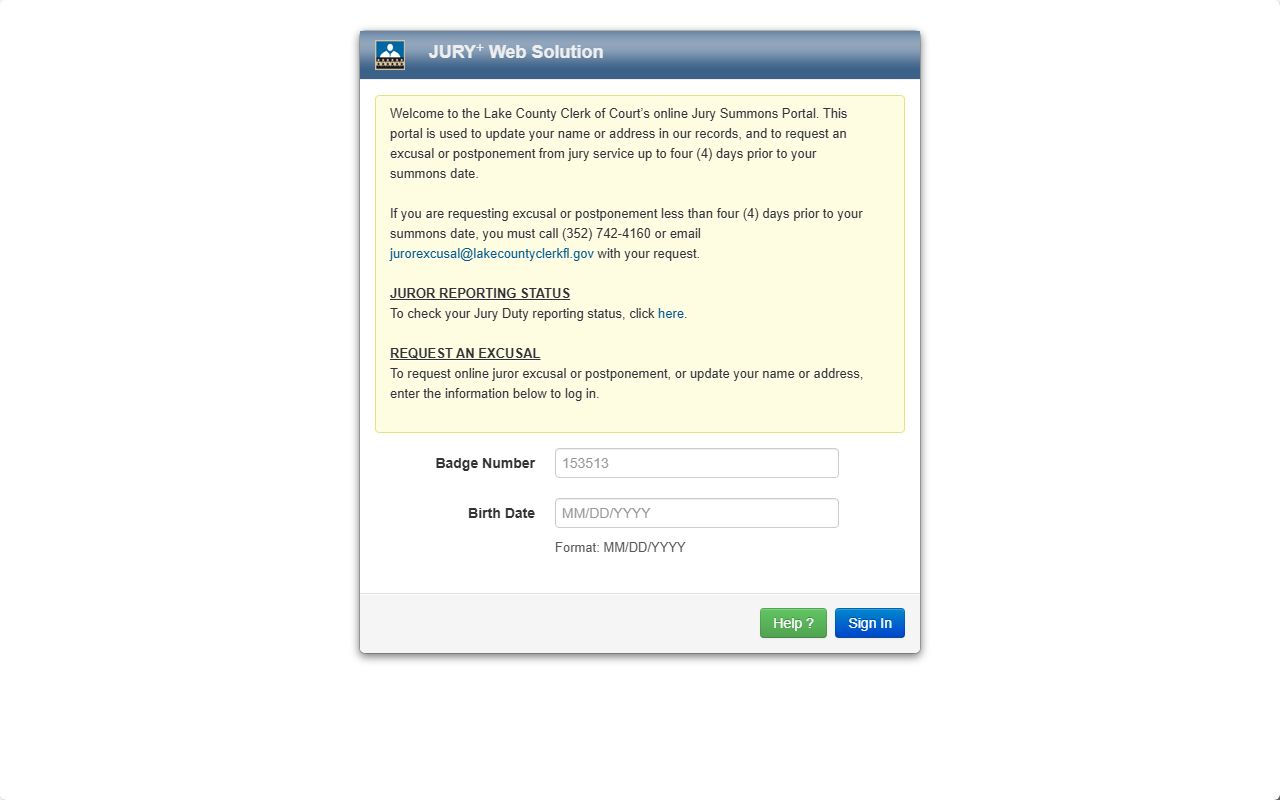
The Clerk's jury login lets summoned jurors check status, confirm reporting times, and complete pre-service tasks before walking into the courthouse.
Case flow: County Court › Circuit Court › Fifth District Court of Appeal › Florida Supreme Court
| Court | Jurisdiction | Case Types |
|---|---|---|
| Florida Supreme Court | Statewide, final | Death penalty, statewide rules, select appeals |
| Fifth District Court of Appeal | District appellate | Appeals from circuit court orders |
| Fifth Judicial Circuit Court | Lake County circuit trial | Felony, circuit civil, family, probate, juvenile |
| Lake County Court | Lake County limited trial | Misdemeanor, traffic, small claims, county civil |
For a deeper view of the trial-level bench, the Lake County Circuit Court page covers judges, divisions, and where each calendar meets. The court dockets page tracks day-to-day calendars by judge.
Circuit, County, and Municipal Compared
Lake County users often confuse the three trial-level forums. Circuit Court hears the most serious cases. County Court handles lower-dollar civil and misdemeanor work. Municipal ordinance violations are filed through the county system in Florida and show up as a Court Type in ShowCase, not a separate building. The table below sums up the split.
| Forum | Typical Case Types | Where Filed |
|---|---|---|
| Circuit Court | Felony, circuit civil over the small-claims cap, family law, probate, mental health, juvenile | Clerk at 550 W. Main St., Tavares |
| County Court | Misdemeanor, traffic infractions, small claims, county civil, landlord-tenant | Clerk at 550 W. Main St., Tavares |
| Municipal Ordinance | City code and ordinance violations within Lake County cities | Filed through the Clerk under Municipal Ordinance court type |
The Clerk's criminal division page is the front door for felony and misdemeanor filings. The next image shows that page.
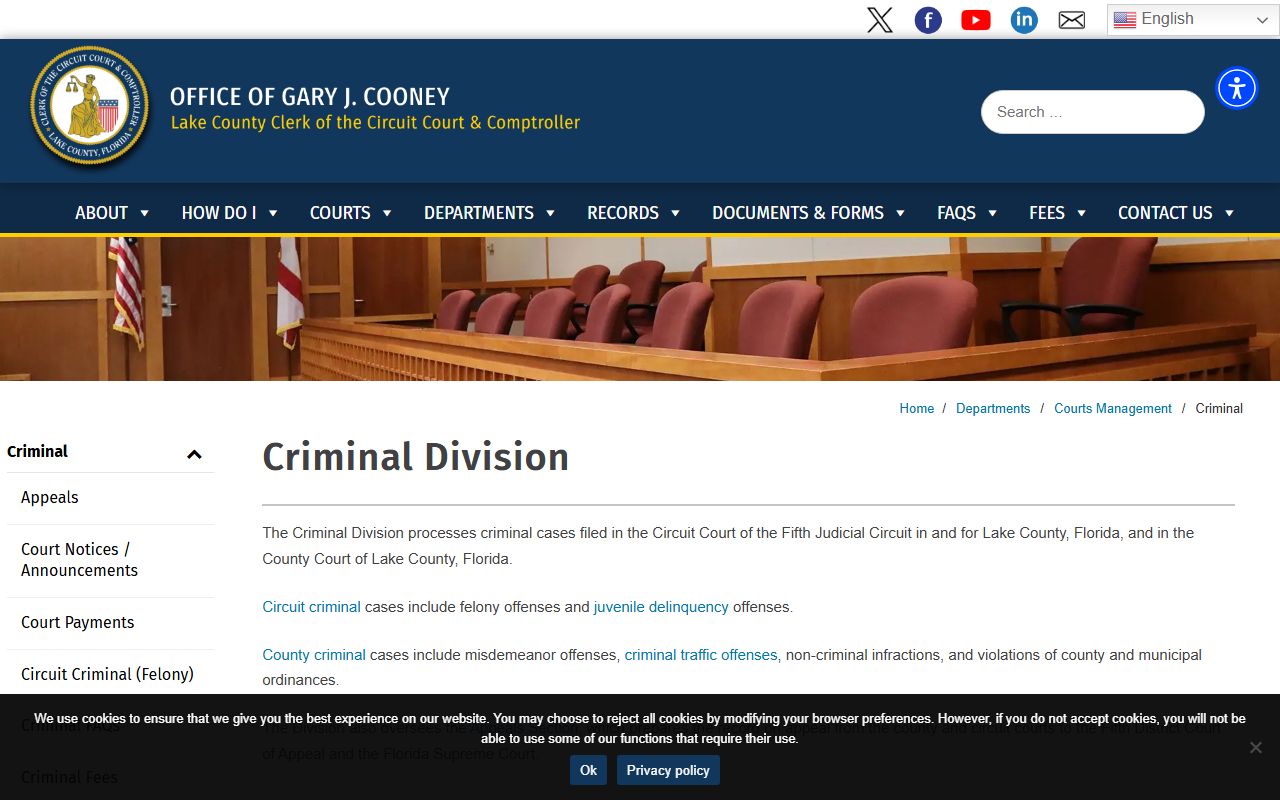
The criminal division page links to expunge and seal forms, criminal fees, and indigent status. It is a good starting point before you try to read a charge sheet in the case portal.
Lake County Courthouses and Offices
The main court building is the Lake County Courthouse at 550 W. Main St. in Tavares. The East Wing holds civil, criminal, traffic, injunctions, domestic relations, probate, guardianship, mental health, jury, and evidence services. The North Wing holds recording, marriage licenses, passports, tax deeds, HR, and purchasing. The detention center is across the street at 551 W. Main St. Free parking is available in an eight-story garage at 200 N. Sinclair Ave. with accessible spaces on the first floor and a seven-foot height clearance.
The Clerk also runs a North Lake Branch at 902 Avenida Central in The Villages of Lady Lake and a South Lake Branch at 290 Citrus Tower Blvd., Suite 116, in Clermont. Both branches handle marriage licenses and passports but do not handle full court case services. Both close for lunch from noon to 1 p.m. The image below shows the official Clerk area resources page, which lists branch locations and outside legal aid contacts.
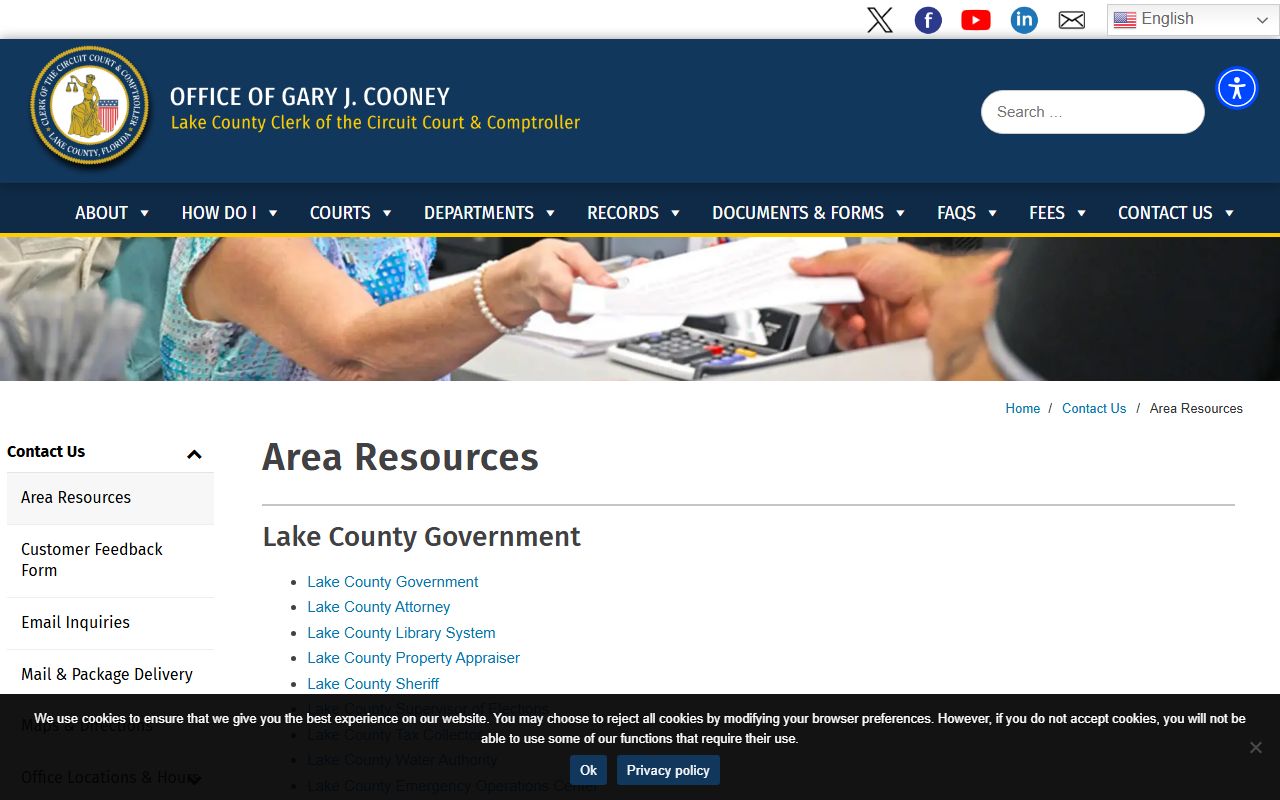
The area resources page is a quick way to find local legal aid, self-help, and outside agency contacts before walking into the courthouse.
Types of Lake County Court Records
Lake County keeps a wide range of case files. Circuit Court records cover the most serious work. County Court records cover smaller civil suits, misdemeanors, and traffic. The Clerk uses ShowCase Court Type codes to sort them. The two-letter code in a case number, such as CF for felony or MM for misdemeanor or TR for traffic, points to the type. Each kind of record has its own access rule and its own set of fields.
Most files have a public side and a confidential side. Adoption, mental health, juvenile, and sealed criminal files are blocked from open search. Even public case files redact some data, such as Social Security numbers and driver's license numbers. The list below is a quick map.
- Criminal records include felony and misdemeanor files with charges, arrest affidavits, pleas, and dispositions.
- Civil records include circuit civil suits, county civil, small claims, replevin, and landlord-tenant evictions.
- Family records cover divorce, child support, custody, paternity, name change, and adoption with limits.
- Probate records cover estates, wills, trusts, guardianship, and mental health filings under one division.
- Traffic records cover civil traffic citations and criminal traffic such as DUI, kept separate from state driver records.
- Official records are deeds, mortgages, and recorded marriage licenses, searched in a separate Acclaim portal.
What Lake County Court Records Show
A typical Lake County case record has dozens of fields. The public ShowCase view exposes most of them on the result row and the case detail tabs. The table below lays out the common ones you will see on a criminal, traffic, or civil result. Some fields show only on certain case types.
| Field | What It Shows |
|---|---|
| Case Number | Florida-style ID such as 35-2026-CF-000553-AXXX-01; the 35 prefix marks Lake County. |
| Court Type | Felony, Misdemeanor, Circuit Civil, Small Claims, Probate, Traffic, and other ShowCase codes. |
| Filing Date | Date the Clerk stamped the case into the system. |
| Parties | Party name, party type, sex, race, DOB, masked SSN and DL. |
| Charges or Cause | Statute, offense level, plea, prosecutor action, and court action. |
| Disposition | Outcome of the charge or claim, such as dismissed, adjudicated, or pending. |
| Sentence or Judgment | Probation, community control, fine, restitution, or money judgment. |
| Docket | Chronological list of filings and orders with hasImages flags. |
| Security Flags | Sealed, expunged, juvenile, adoption, abortion, Jimmy Ryce, and open-warrant flags. |
The ShowCase portal also has a separate Citation Search panel for traffic ticket numbers. The official traffic division page is shown below.
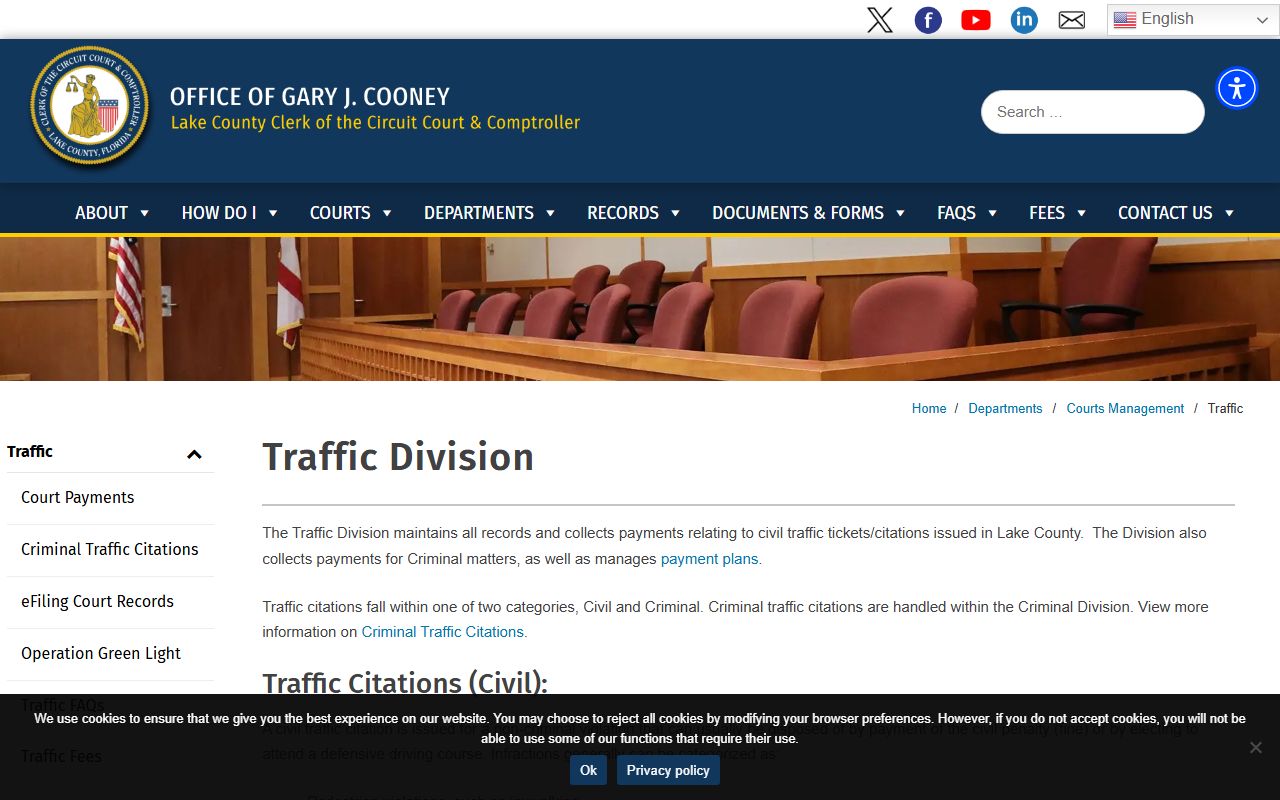
The traffic page also points to online ticket payment options for civil citations and to the criminal traffic team for DUI and other serious traffic cases.
ShowCase Search Fields at a Glance
Knowing what to type in each field saves time. The Clerk's public Case Search uses the same set of fields whether you search a felony, a small claim, or a probate file. The table below shows what each field accepts.
| Field | Type | Notes |
|---|---|---|
| Case Number | Text | Examples: 35-2026-MM-002056-AXXX-01, 35-2026-CF-000553-AXXX-01, 35-2026-TR-007606-AXXX-01. |
| Last Name | Text | Search with Exact, SoundEx, or Starts With. |
| First Name | Text | Often paired with last name; not required alone. |
| Judge | Dropdown | Loads from the live judge list, including current and former Lake County judges. |
| Status | Dropdown | OPEN, REOPEN, CLOSED, APPEAL, PROBATION, COMMUNITY CONTROL, and more. |
| Court Type | Dropdown | Felony, Misdemeanor, Criminal Traffic, Circuit Civil, Small Claims, Probate/Guardianship, and others. |
| Search Type | Radio | Exact, SoundEx, Starts With. |
| Show One Row Per Case | Checkbox | Default on; turn off to see every party row. |
| Citation Search | Text | Separate modal for traffic citation numbers. |
Public Access Laws for Lake County Records
Florida has a strong open-records law. Chapter 119 of the Florida Statutes gives the public a right to inspect and copy non-exempt records. Article I, section 24 of the state constitution backs up that right. Court records have an extra layer of rules under Florida Rule of General Practice and Judicial Administration 2.420. Together these rules set the limits on what the Clerk can post online and what stays sealed.
Key Florida Statutes:
Fla. Stat. ch. 119 sets the baseline state public-records law for nearly all agency records.
Fla. Stat. § 119.07 covers how to inspect and copy records, fees, and exemption procedures.
Fla. Stat. § 119.0714 targets court files and official records, listing personal data that must be kept out of public view.
Fla. Stat. § 943.0585 governs court-ordered expunction of qualifying criminal history.
Fla. Stat. § 28.24 sets the Clerk's service charges for copies, certification, and search work.
The Clerk also follows Florida Supreme Court administrative orders on remote access. Some files require registered-user access for full document images. There is no fee to register or to run a basic public search. More detail lives on the public records page.
Restricted and Confidential Records
Not every Lake County file is open to the public. The Clerk's ShowCase portal uses several flags to mark restricted cases. These include isSealedCase, isNonPublicCase, isExpungedCase, isJuvenileCase, isAdoptionCase, isAbortionCase, and isJimmyRyceCase. Mental health filings, Baker Act petitions, risk protection orders, and substance abuse cases are often confidential. Adoption files are sealed under Fla. Stat. § 63.162. Juvenile justice files fall under Fla. Stat. § 985.04 and stay closed to ordinary public users.
To view a sealed or expunged record, a person usually must show standing under statute or get a court order. The Clerk's expunge and seal page is the local entry point. Applicants typically need an FDLE Certificate of Eligibility first. After review, a petition is filed in the court that handled the case. If the judge grants the order, the Clerk, the arresting agency, and FDLE remove or restrict the record as the statute requires.
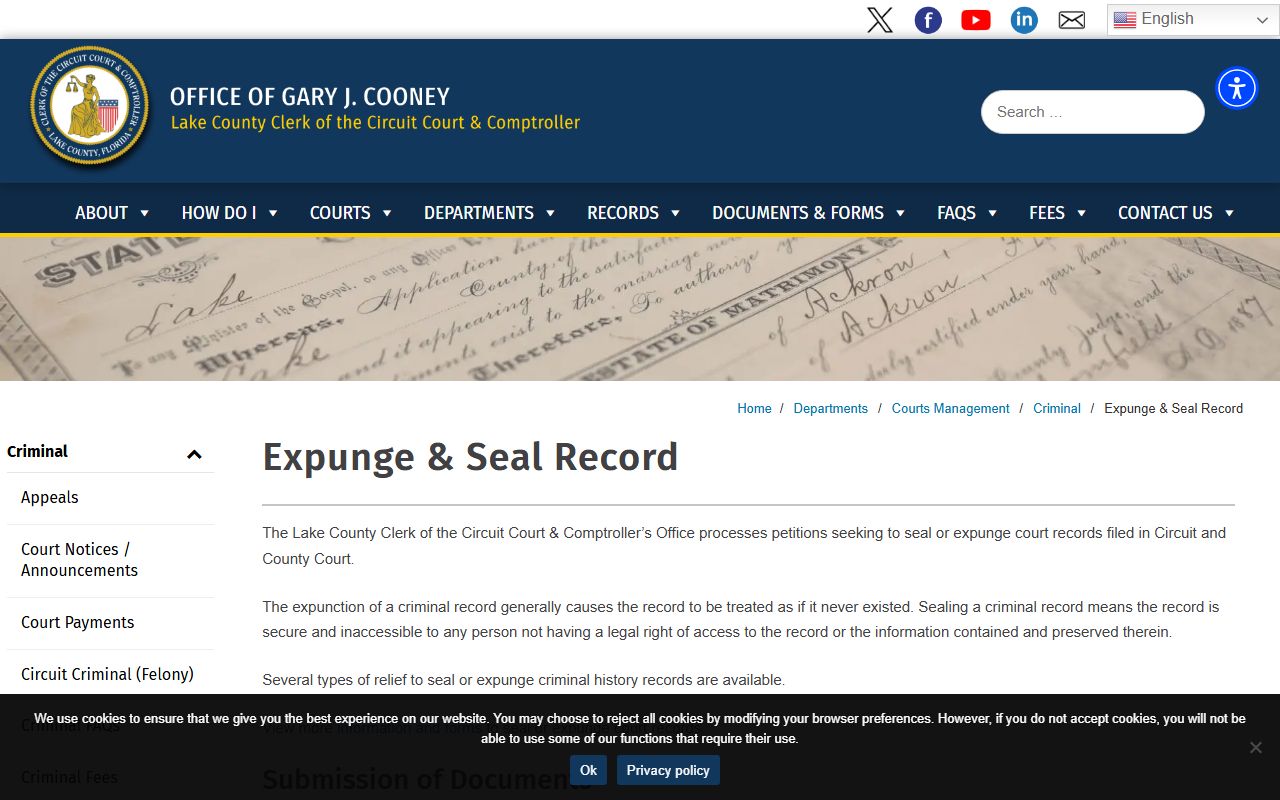
The image above is the Clerk's official expunge and seal page. It is the right place to begin any seal or expunge filing in Lake County.
Note: Sealing and expunction rules in Florida are strict, and many offenses do not qualify; check the statute and talk to a lawyer before filing.
Specialty Courts in Lake County
The Fifth Judicial Circuit lists several programs at the Lake County Courthouse. Veterans Court is one. It is a specialty docket for eligible veterans whose cases tie back to service-connected issues such as substance use, mental health, or housing. Teen Court is the other named diversion program for eligible youth. Both programs aim to swap traditional case processing for treatment, supervision, and restorative steps.
The circuit also runs Civil Case Management, a Self-Help Center, and a Probate Division at the Lake County Courthouse. Civil Case Management is not a treatment court, but it does steer civil cases toward resolution under court-management orders. The Self-Help Center is a key resource for self-represented family-law and small-claims litigants. For probate questions and forms, go to the Lake County probate records page.
The State Attorney for the Fifth Judicial Circuit prosecutes state criminal cases out of the Lake County Courthouse. Bill Gladson holds the office, and his team is profiled on the official State Attorney leadership page.
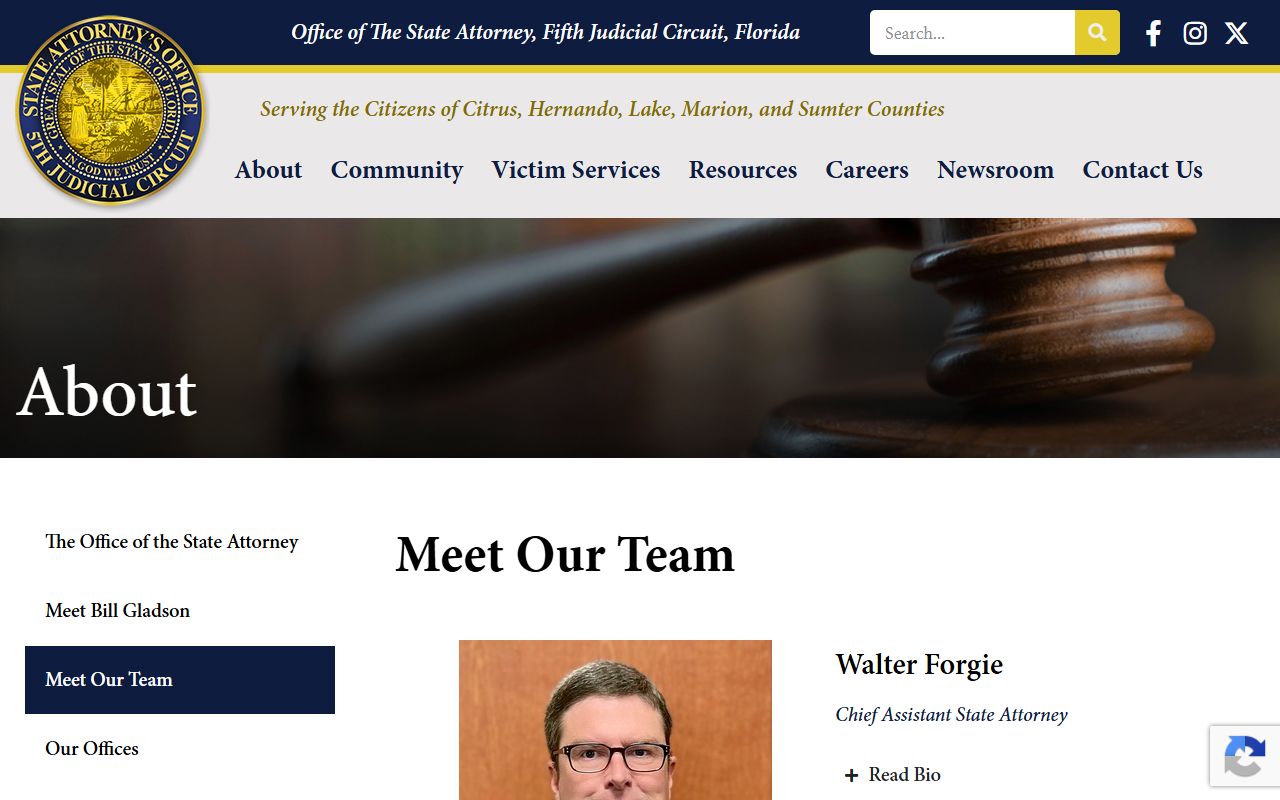
The State Attorney handles felony and misdemeanor prosecution, victim services, and trial work in Lake County. Eligible indigent defendants are represented by the Public Defender, whose office is profiled on the official Public Defender about page.
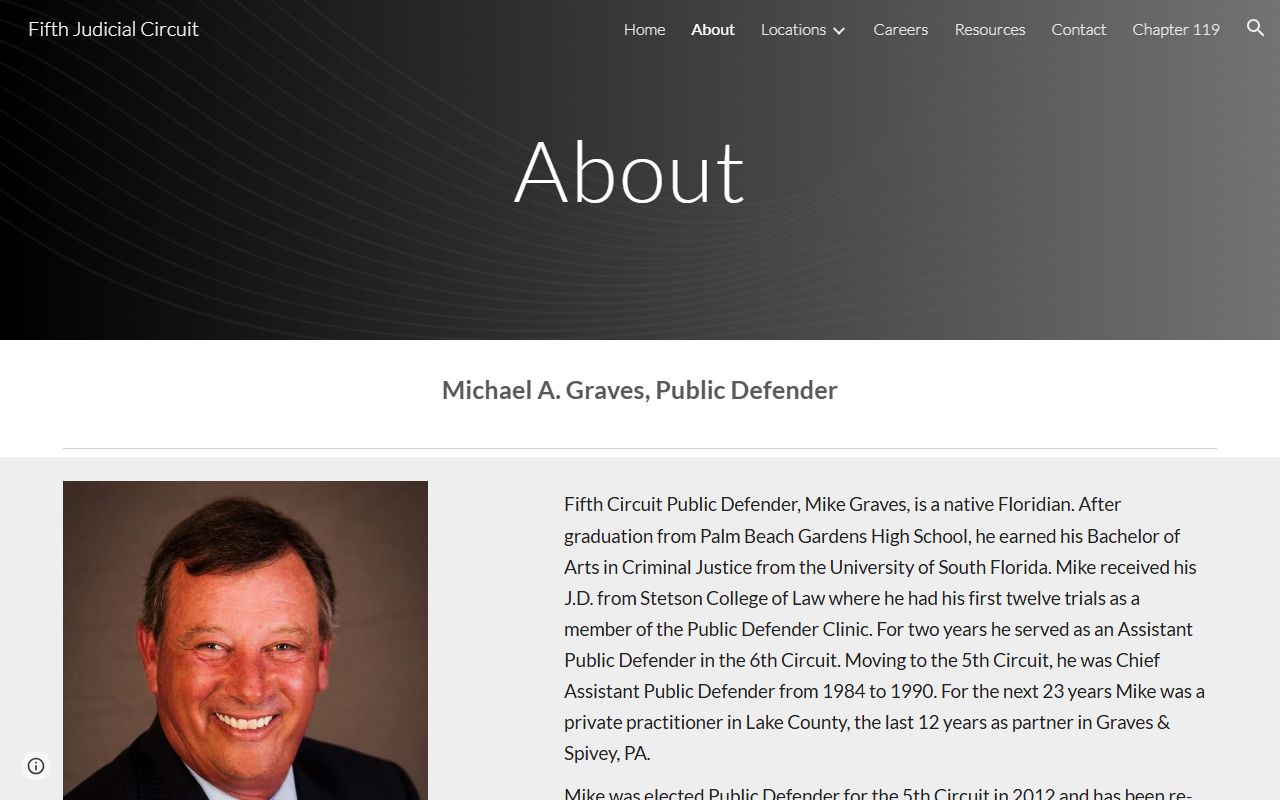
The Public Defender for the Fifth Judicial Circuit is Michael A. Graves. Appointment depends on an indigency screening run through the court, not a simple phone request.
Lake County Sheriff and Jail
The Lake County Sheriff's Office is led by Sheriff Peyton C. Grinnell. The Office of the Sheriff sits at 360 W. Ruby St. in Tavares, with a non-emergency line at 352-343-2101 and an information desk at 352-343-9500. The Lake County Detention Center is the county jail. It was constructed in 1992 and has a capacity of 960. The average daily population is 828, and the jail booked 9,169 people in 2019. The official Corrections Operations page reports 239 personnel, including 179 sworn staff.
To find a person currently in custody, use the official LCSO inmate search. It is name-only by policy. First name needs at least one character. Last name needs at least three. Results show first name, last name, arrest date, age, race, gender, charges, and booking number. For a full breakdown of the roster and profile fields, see the Lake County inmate records page. For active orders to arrest, the warrant records page explains how the ShowCase hasOpenWarrant flag works. For people who have left custody, see the released inmates page, and for daily counts and trends see the inmate population page.
Marriage, Divorce, and Probate Records
The Clerk handles marriage licenses out of the courthouse North Wing and at the North Lake and South Lake branches. Lake County also supports an eMarriage workflow online. Divorce is a court file in the Domestic Relations division. Florida law sets a residency rule under Fla. Stat. § 61.021 and a marriage-license rule under Fla. Stat. § 741.04. Probate falls inside the Circuit Court's Probate Division. For more on each, see the marriage and divorce records page and the probate records page.
- Testator
- A person who has made a valid will.
- Executor
- The person named in a will to carry out its terms; called personal representative in Florida.
- Petitioner
- The party who asks the court for relief in family, probate, injunction, or special proceedings.
- Respondent
- The party who responds to a petition.
- Disposition
- The final outcome of a charge or case, such as dismissed, adjudicated guilty, or judgment for plaintiff.
Lake County Court Fees
The Clerk sets fees under Fla. Stat. § 28.24 and the local fee schedules posted by division. Filing fees vary by case type, and copy and certification fees apply to both court files and official records. The table below points to each official fee page rather than listing dollar amounts that can change. Use the linked pages for the current numbers.
| Fee Category | Source |
|---|---|
| Court data and records fees | Official fee page |
| County and circuit civil fees | Official fee page |
| Criminal fees | Official fee page |
| Domestic relations fees | Official fee page |
| Probate, guardianship and mental health fees | Official fee page |
| Recording fees | Official fee page |
| Traffic fees | Official fee page |
The criminal fees page is shown below.
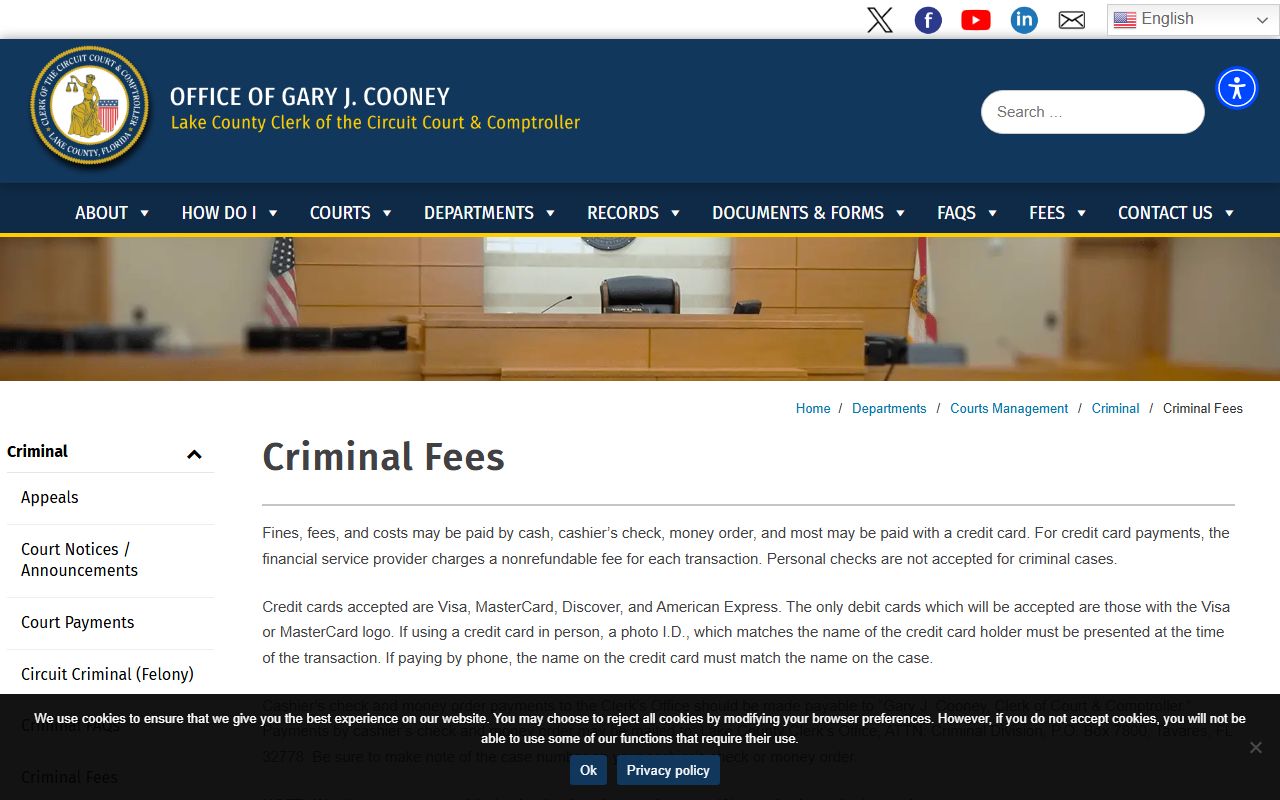
The Clerk's criminal fees page lists the per-action charges set by state statute. Always pull the live page before mailing a payment.
How to Read a Lake County Case Record
Case numbers carry a lot of meaning. In a number like 35-2026-CF-000553-AXXX-01, the 35 marks Lake County, 2026 is the filing year, CF marks a circuit felony, and the rest tracks the sequence and division. MM marks county-court misdemeanor. TR marks traffic. Court Type names on the result row match these codes. A row also lists party type, file date, fee balance, and a hasOpenWarrant flag. Docket lines below show every order and every filing in time order.
Plea entries are short but loaded. Common Florida pleas include guilty, not guilty, and nolo contendere, which is a no-contest plea. Disposition codes show how a charge ended: dismissed, adjudicated, withheld adjudication, transferred, or pending. Many criminal cases include a Notice of Appearance, a Waiver of Arraignment, and a Plea Negotiation Conference entry. Reading the docket from the bottom up is often the easiest way to follow what happened first. The court records page drills deeper into docket reading.
Accuracy and Record Limits
The Clerk does its best to post current data, but the public portal is not always real-time. The official disclaimer warns that index information may not reflect all updates, changes, or rulings that have not posted yet. Sealed or expunged records may not be disclosed. Some old dates are approximated when the original record did not capture a recording date. Image scans run at 300 DPI under Florida Administrative Code rules. The site also has a daily maintenance window from 9 p.m. to midnight that can break access for short periods.
Note: Always verify a case file with the Clerk's office at 352-742-4100 before relying on online data for a court date, bond, or sentence.
History of Lake County Courts
Lake County was created in 1887 from parts of Sumter and Orange Counties. Tavares has held the county seat since the start, and the courthouse district still anchors downtown. The north hall of the current Lake County Courthouse was dedicated as Singeltary Hall. The Fifth Judicial Circuit's own history note ties Lake County to Florida's first Judge of Probate, Dalton Huger Yancey, who served at Bloomfield. Florida's earlier Eastern Judicial Circuit, created by the legislature in 1845, also covered the land that is now Lake County. The Detention Center across Main Street was built in 1992 and earned Florida Corrections Accreditation Commission status in 2006 and NCCHC medical accreditation in 2017.
Frequently Asked Questions
Where do I search Lake County court records?
Start at the Clerk's Search Online Court Records gateway. Read the access notices, then click Accept and Search Court Records to open the ShowCase portal. The direct link is courtrecords.lakecountyclerk.org. The official gateway is the right starting point because it explains image limits, confidentiality, registered-user access, and the daily maintenance window. There is no fee to register or use the service. Do not pay a third-party site for a basic Lake County case search.
Where is the Lake County Courthouse?
The main courthouse is at 550 W. Main St. in Tavares, FL 32778. The Clerk's main phone is 352-742-4100. The Fifth Judicial Circuit lists the courthouse phone as 352-253-1600. The East Wing handles court services such as civil, criminal, traffic, family, probate, and mental health. The North Wing handles recording, marriage licenses, passports, and tax deeds. The Detention Center sits across the street at 551 W. Main St., and the Sheriff's Office is at 360 W. Ruby St.
How do I search for someone in Lake County Jail?
Use the official LCSO inmate search at lcso.org/inmate-search. It is search-by-name only. First name requires at least one character. Last name requires at least three. The page also uses reCAPTCHA. Results show first name, last name, arrest date, age, race, gender, charges, and booking number. The Sheriff's Office warns about scam calls asking for bond money or warrant money by gift card or wire. No Sheriff's Office employee will call to ask for money for an inmate.
Where do I get a marriage license in Lake County?
Marriage licenses are Clerk services. The courthouse North Wing handles licenses, as do the North Lake Branch in The Villages of Lady Lake and the South Lake Branch in Clermont. The Clerk also runs an eMarriage online workflow. Recorded marriage records are searched in the Official Records portal at officialrecords.lakecountyclerk.org. Search by name, book and page, instrument number, record date, or simple search, and try spelling variations because the disclaimer suggests it.
How do I seal or expunge a Lake County record?
Start with the Clerk's Expunge and Seal Record page and read Fla. Stat. § 943.0585 for expunction and Fla. Stat. § 943.059 for sealing. Most applicants need an FDLE Certificate of Eligibility first. Then file a petition in the court that handled the case. If the judge grants the order, the Clerk, the arresting agency, and FDLE process it under the statute. Many offenses do not qualify, so it helps to talk to a lawyer.
More on the Lake County Court Records FAQ page.