
Arrest Records in Lake County
Arrest records in Lake County start with law enforcement. The Lake County Sheriff's Office books people into the Lake County Detention Center at 551 W. Main St., Tavares. City police agencies also make arrests inside Lake County. After booking, the case moves to the Clerk of the Circuit Court & Comptroller, who logs charges and court events under a case number. The Sheriff keeps the booking file. The Clerk keeps the court file. Both feed the same criminal record.
An arrest record is not the same as a conviction. An arrest only means police had probable cause to take someone into custody. The court case decides guilt. For the full court file with pleas, motions, and disposition, see the Lake County court records page. For active warrants, see Lake County warrant records. For current jail custody, see Lake County inmate records.
How to Search Lake County Criminal Records
The Clerk's main portal is ShowCase, a public court records search at courtrecords.lakecountyclerk.org. It covers felony, misdemeanor, criminal traffic, and infraction cases. Search by name, case number, citation number, or attorney. For booking and custody data, use the LCSO inmate search at lcso.org/inmate-search. The Sheriff's tool is now name only, with a reCAPTCHA check, after policy changes to limit scam misuse.
- Open ShowCase at courtrecords.lakecountyclerk.org and accept the user agreement.
- Pick a search type. Name search needs last name and first name. Case search needs the full case number.
- Filter by court type if you want only criminal results. Pick CF for felony, MM for misdemeanor, or CT for criminal traffic.
- Open the case to view docket entries, charges, parties, bond, and events.
- For booking photos and current custody, run the same name on the LCSO inmate search.
Statewide criminal history is a separate search. The Florida Department of Law Enforcement runs a public criminal history check through FDLE Criminal History Records. The portal is called CCHINet. The fee is a flat charge per name. It pulls statewide arrest and disposition data tied to fingerprint events.
Felony vs. Misdemeanor Records
Florida splits criminal cases by court. Felony cases go to the Circuit Court. Misdemeanor cases go to the County Court. Lake County is in the Fifth Judicial Circuit, with Citrus, Hernando, Marion, and Sumter Counties. Felony case numbers carry the CF code. Misdemeanor numbers carry the MM code. The Clerk indexes both, but each has its own filing rules, fees, and procedure. The State Attorney files the formal charge for felonies through an information. Some serious felonies go to a grand jury for an indictment.
The lead-in image below shows the Clerk's felony page, the official entry point for Circuit Criminal cases. See it at the Clerk's felony division page.
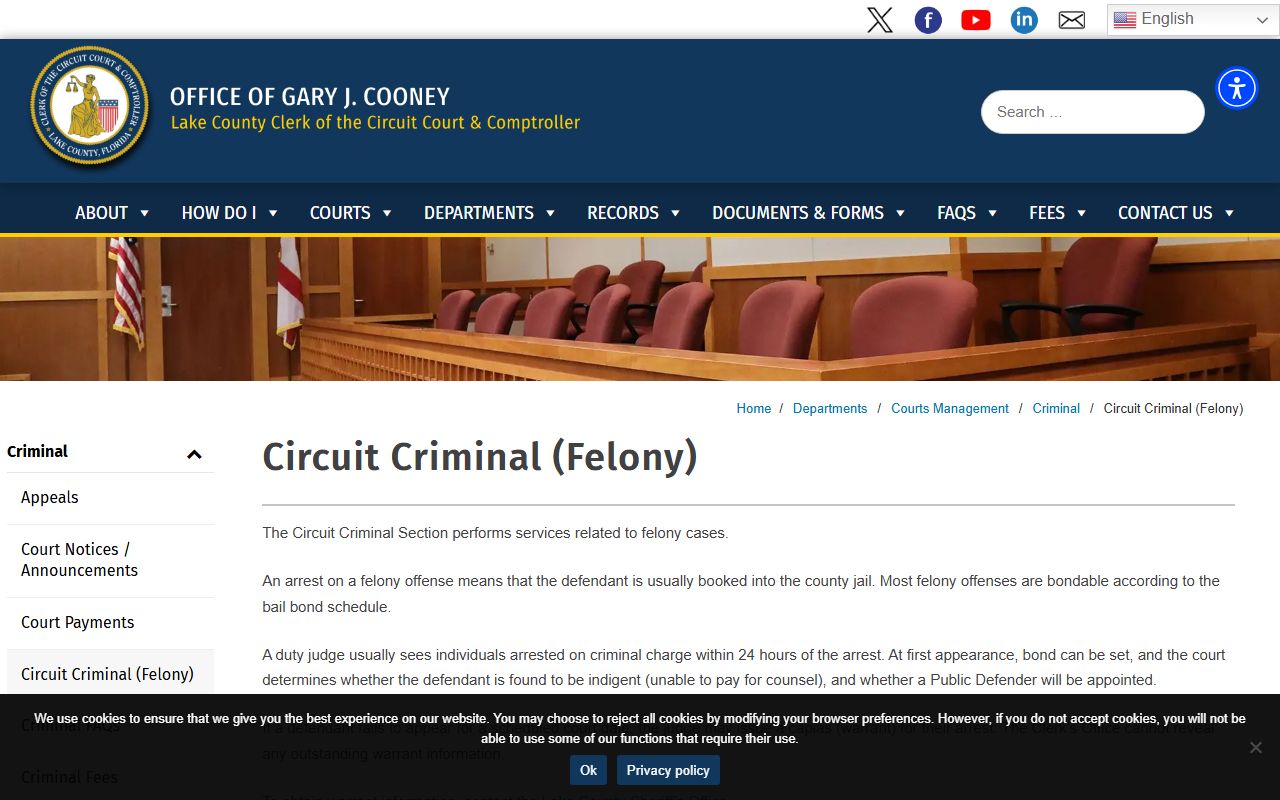
The page links to forms, fee data, and the ShowCase search used for felony lookups. It is the right start for any Lake County felony case search.
Misdemeanor cases run under a parallel page. See the official misdemeanor division at the Clerk's misdemeanor page.
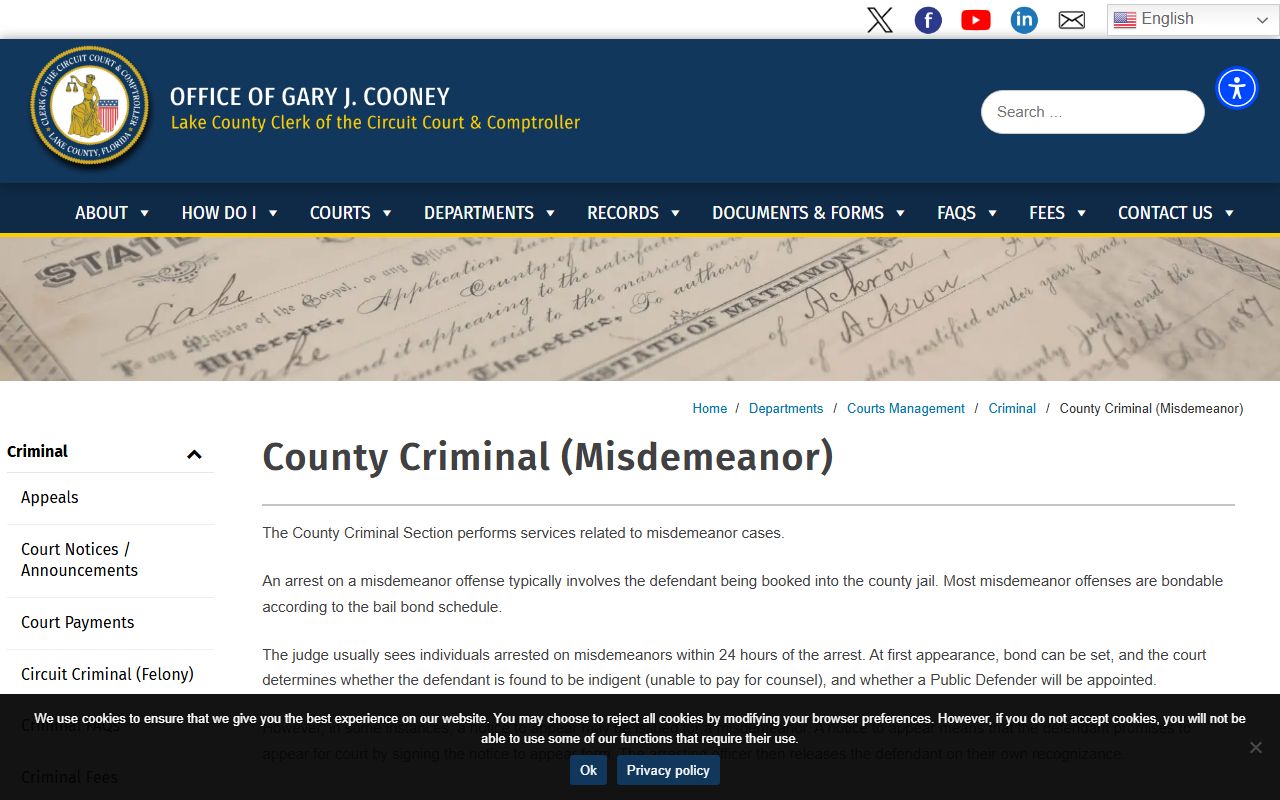
The misdemeanor page mirrors the felony layout, but cases there carry lighter max penalties. County Court handles charges with up to one year in jail.
Criminal Traffic and Ordinance Cases
Not every traffic case is a simple ticket. Florida treats some driving offenses as criminal, not civil. Driving under the influence is the most common one. Driving while license suspended with knowledge, leaving the scene of a crash, and reckless driving can also be criminal. These show up under the CT code in ShowCase, not the TR civil traffic code. They live on a person's criminal history, not just the driving record.
Ordinance violations are local rules set by Lake County or by a city. Some are civil. Some are criminal. The Clerk lists ordinance violations as a court type, and the case may take a code such as CO. For DUI and other criminal driving cases, see the Lake County traffic court records page for added detail. A simple traffic ticket without a criminal charge will not appear under criminal court search filters.
Arrest Affidavits and Charging Documents
An arrest affidavit is the sworn statement an officer files at booking. It states the date, time, and place of the arrest, the officer's account of probable cause, the charges, and the booking data. The affidavit is part of the criminal case file at the Clerk. It often appears as a docket entry on the first day of the case.
The formal charge comes next. For felonies, the State Attorney files an information that lists each count, the statute, and the offense level. For some grand-jury cases, the charging paper is an indictment. For misdemeanors, the State Attorney files an information as well. Some cases proceed on the citation or notice to appear. Each charging paper is searchable by case number on ShowCase.
Charges, Pleas, and Dispositions
A criminal case record in Lake County tracks each charge through plea and disposition. The ShowCase docket lists the steps in order. A typical case has many entries, from arrest affidavit and first appearance to plea negotiation, written plea, information, and final order. The fields below show what shows up on a public criminal case file.
| Field | Sample Value | Notes |
|---|---|---|
| Case Number | 35-2026-CF-000553-AXXX-01 | Prefix 35 marks Lake County; CF marks felony. |
| Party Type | Defendant | State of Florida is plaintiff in criminal cases. |
| Offense Date | 2026-01-14 | Date the alleged act took place. |
| Arrest Date | 2026-01-14 | Date the person was taken into custody. |
| Statute | Fla. Stat. § 893.13 | Cited charge with offense level. |
| Plea | Not guilty | Guilty, not guilty, or nolo contendere. |
| Disposition | Adjudicated guilty | Final outcome on each count. |
| Bond Amount | $5,000 | Set at first appearance. |
| Fee Balance | $0.00 | Court costs, fines, and fees due. |
A charge is not a conviction. The two terms get mixed up in news and online lookups, but the law treats them apart. The table below sets out the key gaps.
| Aspect | Charge | Conviction |
|---|---|---|
| Stage | Filed at start of case | Entered at end of case |
| Burden of Proof | Probable cause | Beyond reasonable doubt |
| Decision Maker | State Attorney files it | Judge or jury rules |
| Plea Effect | Defendant has not yet pled | Guilty plea or trial verdict |
| Outcome Range | May be dropped or amended | Sentence, probation, or fines apply |
| Public Record | Yes, on the docket | Yes, on the disposition |
Bonds, Warrants, and Capiases
Bond data shows on the case file and on the booking file. The court sets bond at first appearance. The Sheriff lists two ways to bond someone out: a licensed bail bond agency, or full cash, a cashier's or certified check, or a money order at the detention center lobby. Local checks pay to the Clerk of Courts. Out of county checks pay to Lake County Sheriff. Call bond verification at 352-742-4024.
A warrant is a court order to arrest. A capias is a similar order, often issued when a defendant fails to appear or fails to comply. Both appear on the criminal case docket. Both can also appear as separate Sheriff records before the arrest happens. For active warrants, see the Lake County warrant records page.
Note: Scammers sometimes pose as bond agents or Sheriff staff. Real LCSO employees and bond agents will not ask for gift cards or wire transfers.
Sealing and Expunging in Lake County
Florida lets some people clear a criminal record. Two laws control the process. Sealing is set out in Fla. Stat. § 943.059. Expunction is set out in Fla. Stat. § 943.0585. The Clerk's expunge and seal page at the official expunge/seal page is the local entry point for Lake County cases.
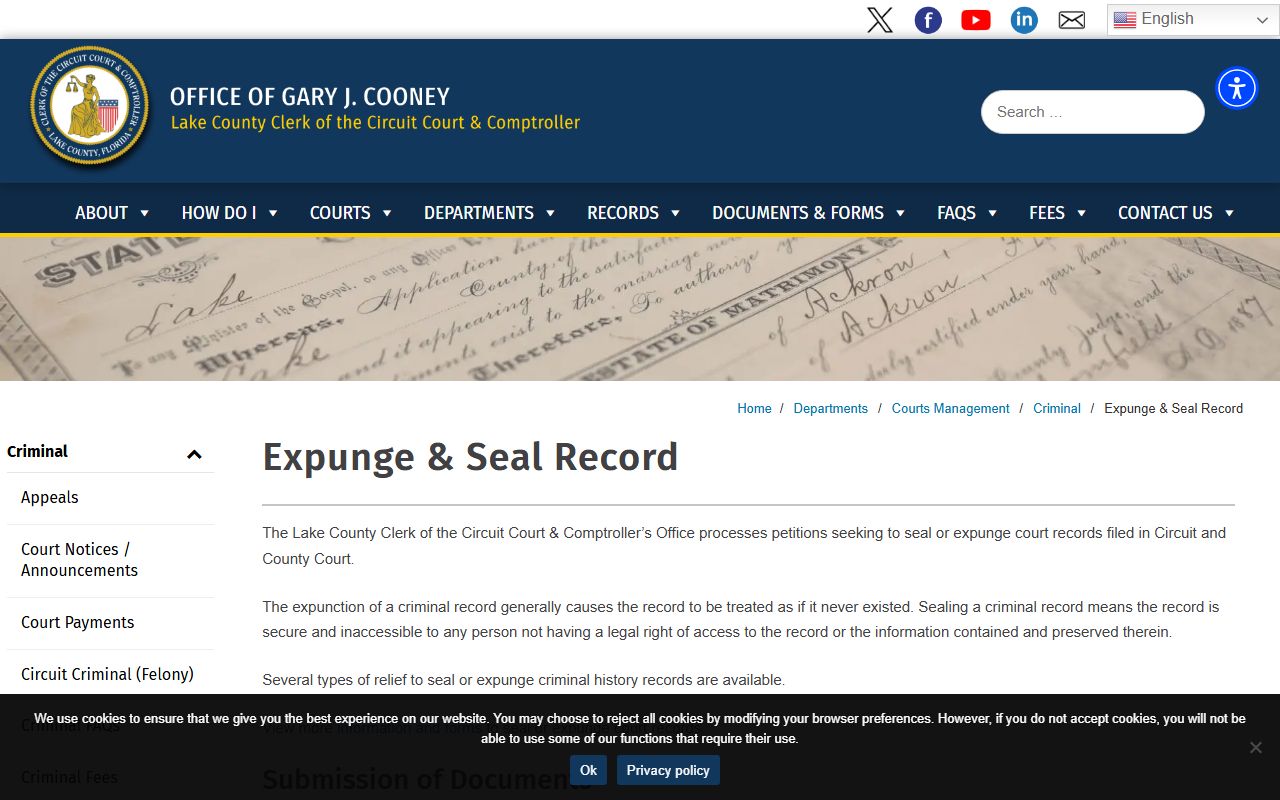
The page links to FDLE forms, fee data, and filing steps for a Lake County petition. It does not handle eligibility decisions on its own.
- Apply to FDLE for a Certificate of Eligibility. Use the FDLE expunge and seal forms.
- Wait for FDLE to issue the certificate. The review can take a few months.
- File the petition in the Lake County court that handled the case. Attach the certificate and a sworn statement.
- Serve the State Attorney and the arresting agency. Both may respond.
- Attend the hearing if the judge sets one. The judge enters an order to seal or to expunge if the case qualifies.
- The Clerk, FDLE, and the arresting agency act on the order to remove or restrict the record.
Sealing and expunction sound alike, but they work in different ways. The table below sets out the main gaps.
| Aspect | Sealed § 943.059 | Expunged § 943.0585 |
|---|---|---|
| Public Access | Hidden from ordinary public view | Treated as if it never existed |
| Record Status | Kept on file but confidential | Physically destroyed or restricted |
| Law Enforcement Access | Permitted with limits | Very narrow access only |
| FDLE Step | Certificate of Eligibility needed | Certificate of Eligibility needed |
| Eligibility | No prior conviction and no prior seal/expunge | Charges dismissed or never filed, plus no prior conviction |
| Denial of Arrest | Allowed in many settings | Allowed in many settings |
| Exceptions | Bar admission, sensitive jobs, criminal justice work | Bar admission, sensitive jobs, criminal justice work |
Some cases never qualify. Statute lists certain offenses that cannot be sealed or expunged, even with a dismissal. A prior seal or expunge in any state can bar a second petition. Missing paperwork is the most common reason for a denied petition.
Lake County Jail Search Connection
The Lake County Detention Center holds people from arrest through first appearance and beyond. The capacity is 960. The average daily population sits around 828. The Sheriff reports 9,169 bookings in a recent year. The center has FCAC accreditation since 2006 and NCCHC medical accreditation since 2017.
The inmate search at lcso.org/inmate-search covers current custody. The result list shows first name, last name, arrest date, age, race, gender, charges, and booking number. The full profile shows DOB, booking photos, arresting officer, bond amount, court date, and case number. For released inmates and longer custody data, see the Lake County inmate records page. State prison data lives at the Florida Department of Corrections.
State Attorney and Public Defender
Florida calls the prosecutor the State Attorney, not District Attorney. The Fifth Judicial Circuit State Attorney handles Lake County criminal cases. Bill Gladson is the elected State Attorney. The office is at 550 W. Main St., Tavares, FL 32778. The phone is 352-742-4236. The State Attorney files the information that turns an arrest into a court case and handles plea offers, trial, and victim and witness services.
The Public Defender for the Fifth Judicial Circuit is Michael A. Graves. The office is at 123 N. Sinclair Ave., Tavares, FL 32778. The phone is 352-742-4270. The Public Defender represents eligible indigent defendants. Eligibility runs through an indigency application. Both offices appear as parties on the case docket in ShowCase, alongside notices from the Clerk of Court.
Confidential Juvenile Criminal Records
Juvenile delinquency cases are confidential under Fla. Stat. § 985.04. The law keeps most juvenile justice records out of the ordinary public view. Access is limited to the child, parents or guardians, attorneys of record, certain agencies, and people the court allows. ShowCase carries a juvenile case flag that hides juvenile data from public results. The Clerk's criminal menu lists Juvenile Delinquency as a category. The image below shows the criminal division page where juvenile, felony, and misdemeanor entry points live side by side. See the Clerk's criminal division page.
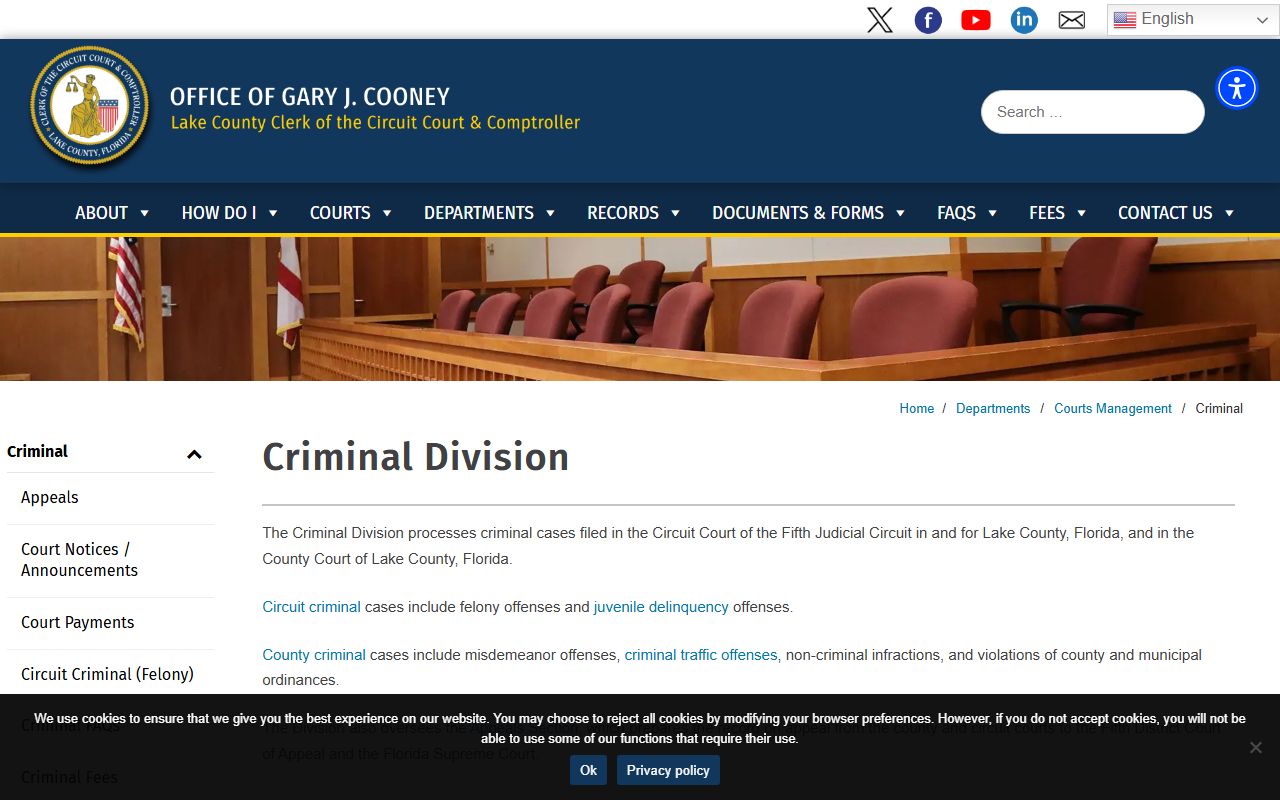
The page groups all criminal case types, including the expunge and seal entry, in one place. It is the best top-level start for Lake County criminal record needs.
Some juvenile data can become public if the case is transferred to adult court. A serious felony charge can move a juvenile to circuit court as an adult defendant. The case then takes the CF code and is open on ShowCase like any felony.
Florida Sex Offender Registry Considerations
Florida runs a statewide sex offender and predator registry. The Florida Department of Law Enforcement hosts it at offender.fdle.state.fl.us. Registration rules are set in Fla. Stat. § 943.0435. Predator status comes from Fla. Stat. § 775.21. The registry is public by design. The registry lists name, photo, address, vehicles, employment data, and the offenses that triggered the duty to register.
Registry data is separate from the Clerk's case file. A person can be on the registry years after the court case has closed. To find a Lake County resident on the registry, search by name, zip code, or city in the FDLE tool. The Sheriff's Office also keeps a local registry liaison.
Note: Registry status is set by statute. A sealed or expunged case can still leave a person on the registry if the underlying conviction triggered registration.
Background Checks and Statewide Records
Background checks come in many forms. A casual lookup on ShowCase shows Lake County court data only. A statewide check needs FDLE. The Florida criminal history search is called CCHINet and runs through FDLE Criminal History Records. The flat fee covers a name-based search of statewide arrest and disposition data.
Background checks for jobs, housing, credit, or insurance fall under the federal Fair Credit Reporting Act. FCRA work has to go through a regulated consumer reporting agency. ShowCase, the Sheriff's inmate search, and FDLE CCHINet are direct government sources, not FCRA-regulated reports. For more on related searches, see the court records, court dockets, and FAQ pages.
Important: This site is not an FCRA-regulated consumer reporting agency. Data here may not be used for credit, hiring, housing, insurance, or other FCRA-regulated decisions.