
How to Find Recently Released Lake County Inmates
The Lake County Sheriff's Office runs the local inmate search but does not post a public "recent releases" list. The LCSO inmate search is name-only by design. LCSO has said this helps cut down on scams that target families in custody cases. The profile page for each inmate shows a Released Date/Time field, so a confirmed release reads off a known booking record. If the person is gone from the search, that is the first clue.
For releases in the last day or two, the fastest path is the jail itself. The Lake County Jail at 551 W. Main St., Tavares answers records calls at 352-742-4000. Corrections Operations is at 352-742-4006 for status questions, and the bond desk is at 352-742-4024. Older releases may still show in archived booking screens. State and federal locators fill the gap for sentenced people.
The image below comes from the LCSO website. Visit the Sheriff's Office home page to start a search or to find the corrections page.
The home page links to the inmate search, the corrections bureau, and victim notification.
Setting Up Release Notifications With VINELink
VINELink is the official victim and family notification service used by Florida agencies, including LCSO. The Sheriff's corrections page labels the tool "V.I.N.E." and points to vinelink.com. Anyone can register, but the service was built for victims who need to know when an offender is released, transferred, or escapes. Alerts are free and go out by phone, email, or text. Setup takes a few minutes. A four-digit PIN is required to confirm or stop a phone alert.
- Open vinelink.com and pick Florida from the state list.
- Search by first and last name, or by booking number if known.
- Open the matching record and select Register for Notifications.
- Choose phone, email, text, or a mix, and set a four-digit PIN.
- Confirm the contact info and save. The alert will fire on custody changes.
The image below shows the official VINELink portal that LCSO links to. Open VINELink to start an alert.
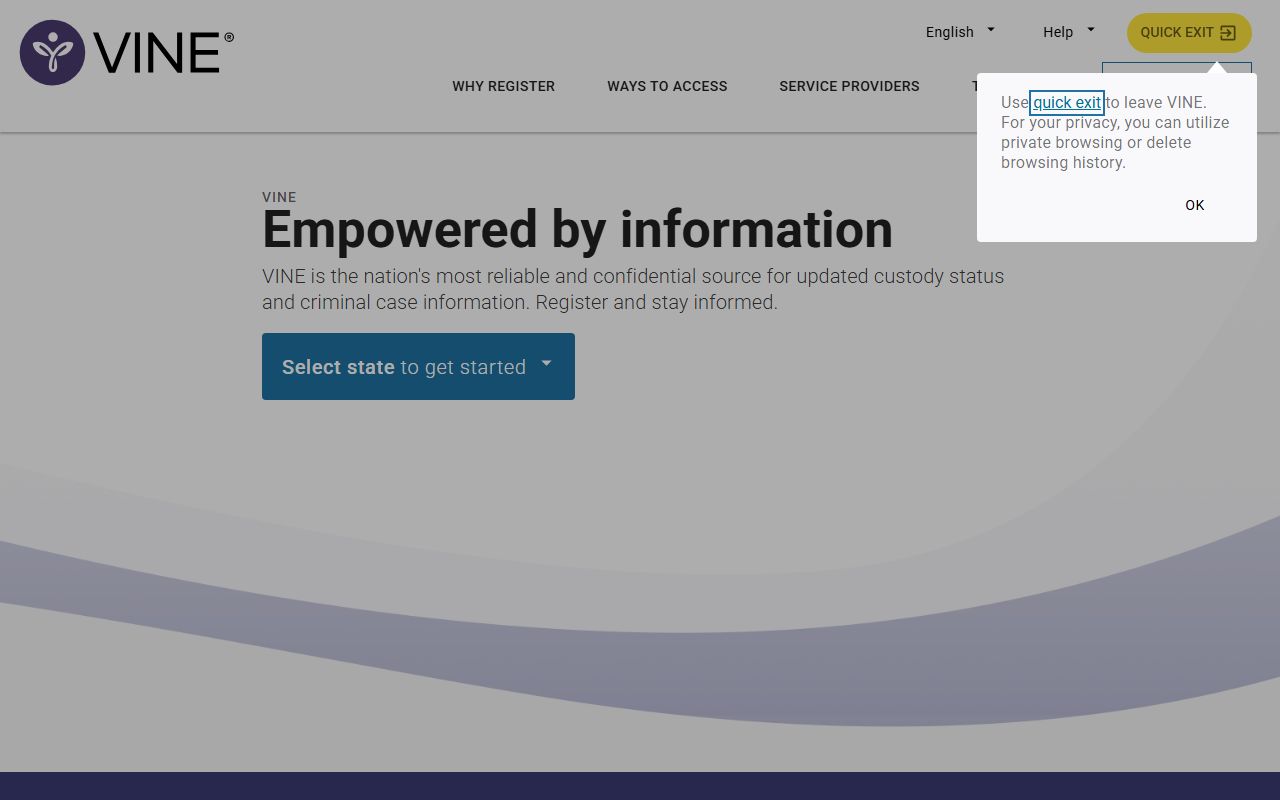
VINELink works best for current jail custody. State releases also feed the system in most cases, which makes it a good first stop for any family member who wants advance notice.
Note: VINELink alerts can lag by a few hours, so always call the jail when an exact release time matters for pickup or safety planning.
Searching the FDC Inmate Release Database
State sentenced inmates do not stay in the county jail. Once a felony sentence sends a person to state prison, the search moves to the Florida Department of Corrections. The FDC Inmate Release Information Search covers people who have been released or are scheduled to be released. FDC says the release database is updated nightly. The wider FDC offender search menu also includes inmate population, escape, supervised population, and absconder lists.
FDC scope is limited. The data covers felony offenders sentenced to the Department of Corrections, meaning state prison or state supervision. County jail and county probation are not in FDC. A person sentenced to state prison can drop off the LCSO roster and appear in FDC within a few days. The name search is begins-with, so a partial last name still pulls a useful list.
| Field Label | Type | Required | Notes |
|---|---|---|---|
| Last Name | Text | One or more search fields | Begins-with match on the committed name. |
| First Name | Text | Optional | Same begins-with behavior as last name. |
| DC Number | Text | Optional | Six characters, numeric or one alpha plus five numeric. |
| Search aliases? | Checkbox | Optional | If checked, aliases are searched as well. |
| Do not show photos | Checkbox | Optional | Speeds up the list view; photo stays on detail page. |
| Show only offenders with photos | Checkbox | Optional | Filters out records without an image. |
| Matches per page | Dropdown | Optional | 10, 15, 20, 25, 30, 35, 40, 45, or 50. |
The screenshot below is the FDC release search page that handles these fields. Open the FDC inmate release search to run a query.
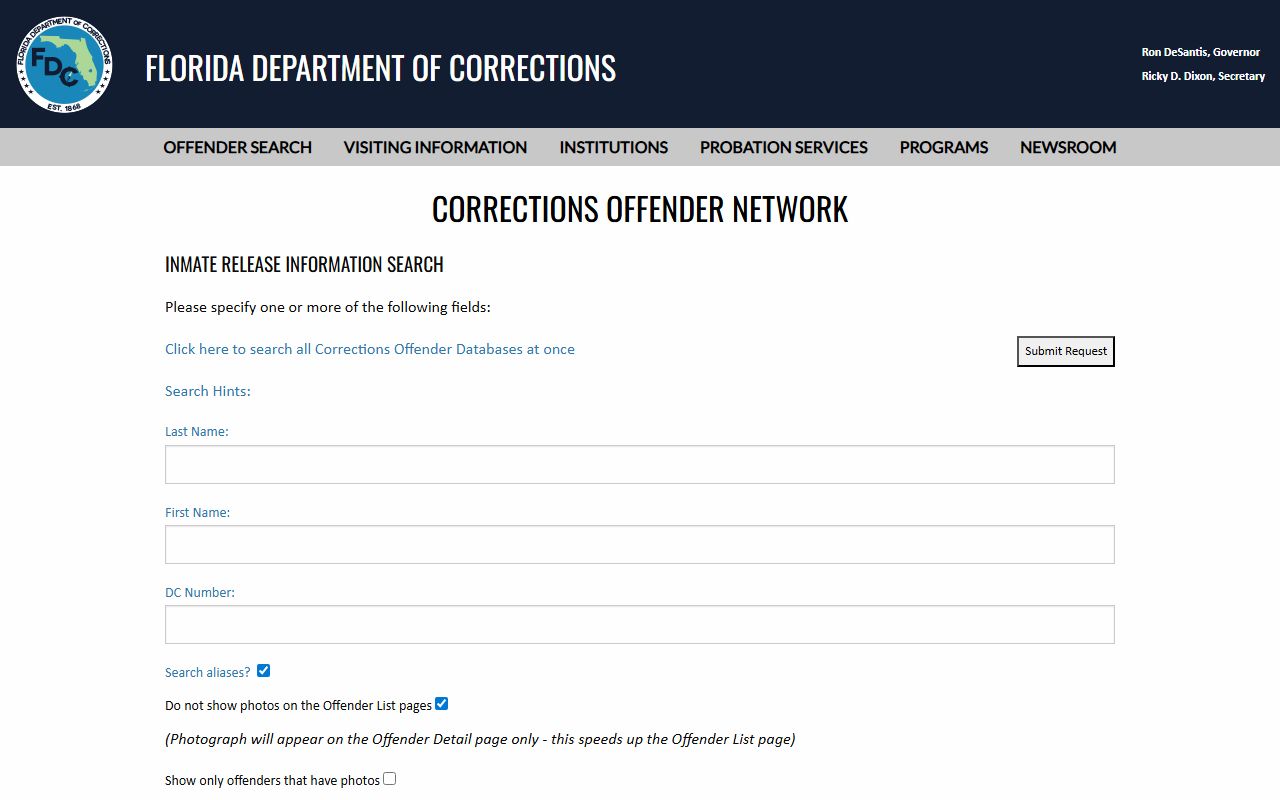
The result list shows the committed name, race, sex, date of birth, current location, and the release date when one is set.
Using the BOP Inmate Locator for Federal Releases
Federal cases tied to Lake County run through the U.S. District Court for the Middle District of Florida, Ocala Division. A person convicted there and sent to federal prison will not appear in FDC or LCSO. Use the BOP inmate locator instead. The site covers federal inmates incarcerated from 1982 to the present. A "Released" or "Not in BOP Custody" status means the person is no longer in BOP custody, but may still be on supervised release or in another setting.
BOP warns that First Step Act sentence reviews and Federal Time Credit changes can make a posted release date out of step with the actual date. Treat a BOP release date as a planning estimate.
| Field Label | Type | Required | Notes |
|---|---|---|---|
| Find By Number tab | Tab | Optional | Search by a federal ID number. |
| Type of Number | Radio or dropdown | Required for number search | BOP Register Number, DCDC Number, FBI Number, or INS Number. |
| Number | Text | Required for number search | BOP Register Number format: #####-###. |
| Find By Name tab | Tab | Optional | Search by name and demographics. |
| First | Text | Required on name page | First name as committed. |
| Middle | Text | Optional | Helps narrow common names. |
| Last | Text | Required on name page | Last name as committed. |
| Race | Dropdown or radio | Optional | American Indian, Asian, Black, or White. |
| Age | Text or dropdown | Optional | Age filter for narrowing results. |
| Sex | Radio | Optional | Male or Female. |
The screenshot below shows the BOP locator with both tabs. Open the BOP inmate locator to run a federal search.
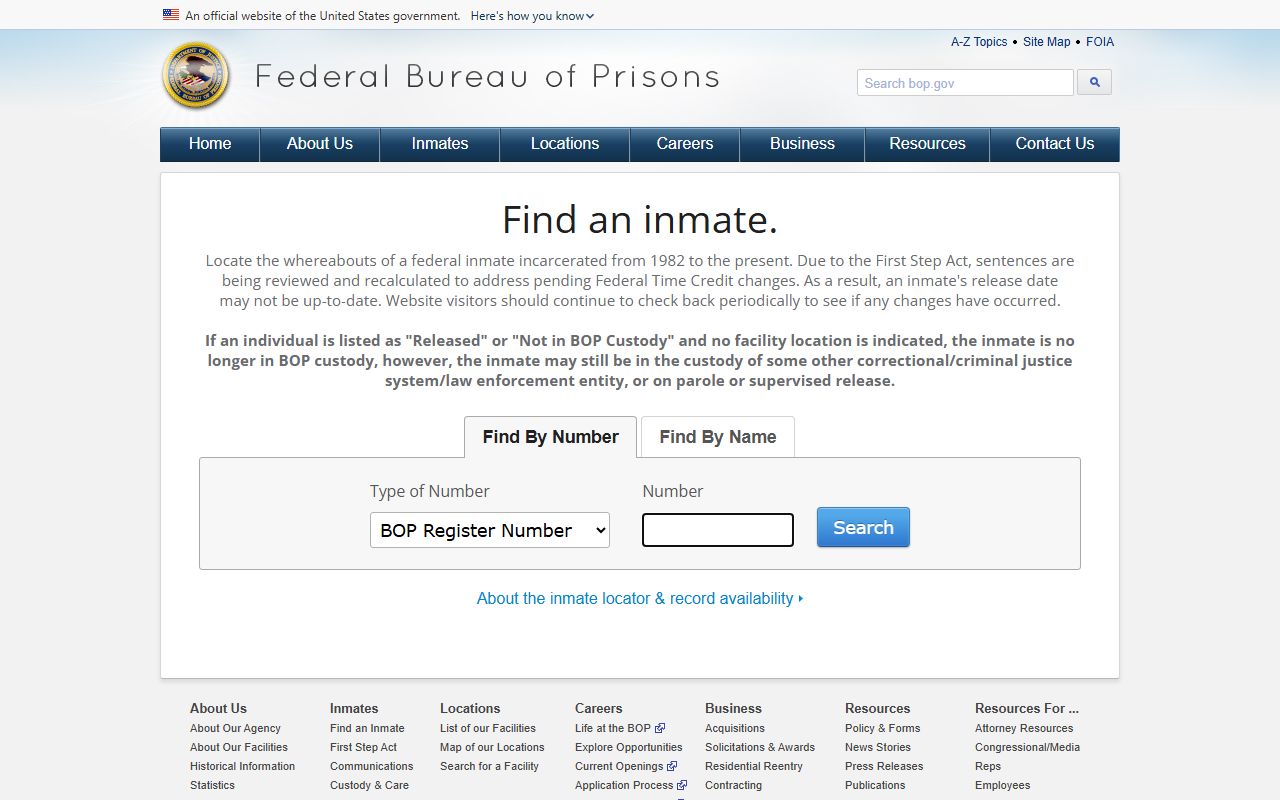
Each result links to a federal facility code that can be cross-checked against the BOP facility directory.
The FDLE Sex Offender Registry
Some Lake County releases trigger a registration duty. FDLE runs the public registry at offender.fdle.state.fl.us. The registry covers people designated under Fla. Stat. § 775.21 and § 943.0435. Search by name, by neighborhood, by university or campus, or by internet identifier. FDLE notes that data is reported by DOC, DHSMV, law enforcement, and offenders themselves, and that FDLE compiles it without independently confirming accuracy.
| Field Label | Type | Required | Notes |
|---|---|---|---|
| First Name | Text | Optional | Offender search tab. |
| Last Name | Text | Optional | Offender search tab. |
| Address | Text | Required for neighborhood search | Used as the search center point. |
| City | Text | Optional | Refines a neighborhood query. |
| Zip Code | Text | Optional | Refines a neighborhood query. |
| Radius | Dropdown or radio | Required for neighborhood search | 1/4, 1/2, 1, 2, 3, 4, or 5 mile. |
| Search tabs | Tab or menu | Optional | Offender, Neighborhood, University, or Internet Identifier. |
Result records list name, designation, address, legal status, crime code, a flyer link, and a public map. Legal statuses include Absconded, Civil Commitment, Confinement, Deceased, Deported, Released - Subject to Registration, and various Supervised statuses. FDLE offers free email alerts when a registered offender moves into a neighborhood. To report a suspected error, call 1-888-357-7332 or email sexpred@fdle.state.fl.us.
Note: Not every released inmate is on the registry. Most felony releases are not, and the registry is only for offenses listed in the cited statutes.
Verifying a Release in Person or By Phone
Online tools lag. A phone call gets a live answer in most cases. For local jail releases, call the Lake County Jail at 352-742-4000. The Detention Center contact line is 352-742-4006, and bond questions go to 352-742-4024. Walk-in visits are possible, but staff will steer most release questions back to the phone.
Lake County Jail (Detention Center)
551 W. Main St.
Tavares, FL 32778
Jail main: 352-742-4000
Corrections Operations: 352-742-4006
Bond verification: 352-742-4024
For state prison releases, call the FDC institution where the person was last housed. The institution number is shown on the inmate detail page. For federal releases, contact the BOP facility listed on the locator record.
Parole and Probation Information
Florida abolished discretionary parole for most felonies committed on or after October 1, 1983. The Florida Commission on Offender Review still handles parole for older cases, plus conditional medical release and clemency. The bigger group of supervised people are on probation or post-prison community supervision, run by FDC. A Lake County resident on probation reports to a circuit probation officer in the Fifth Judicial Circuit.
It helps to know the words on the paperwork. Common terms get mixed up, and the wrong term can lead to the wrong agency.
- Parole
- Early release from a state prison sentence under conditions set by the Florida Commission on Offender Review. Rare in Florida because of the 1983 law change.
- Probation
- A court-ordered period of supervision in the community, often in place of jail or after a split sentence. Supervised by FDC probation officers.
- Supervised Release
- The federal term for post-prison community supervision. Imposed by a U.S. district judge and run by U.S. Probation in the Middle District of Florida.
- Civil Commitment
- Continued confinement of a sexually violent predator after a prison term ends, under the Jimmy Ryce Act. The person is in state custody, not free, even though the criminal sentence has ended.
Violations of parole or probation are reported by the supervising officer, and a warrant can issue. Active warrants tied to a Lake County violation show up through the warrant records channels and on the jail roster once the person is booked.
Reentry Resources in Lake County
Reentry starts before the release date. LCSO program material lists recovery groups, GED programming, chaplaincy, and LifeStream Behavioral Center groups offered to inmates ahead of release. For people released in Tavares, transportation, ID, housing, and benefits are the four most common first-day needs. The Clerk of the Circuit Court & Comptroller handles court paperwork like fines and future court dates.
- LifeStream Behavioral Center, behavioral health and substance use services, used in pre-release groups.
- LCSO chaplaincy program, faith-based support and post-release referrals.
- GED programming through the jail, completed certificates carry into the community.
- Public Defender's Office at 352-742-4270 for follow-up questions on a current case.
- Clerk of Court at 352-742-4100 for court fees, fine plans, and future hearing dates.
Faith-based and recovery groups outside the jail also work with people who just got out. CareerSource Central Florida serves Lake County for job placement. Public transit in the county is limited, so arranging a ride before release is part of a good plan.
Property, Paperwork, and Court Dates After Release
Property pickup at the jail is the first stop for most people. Wallets, phones, and clothing are returned at release, and the receipt should be kept in case of a missing item claim. Cash on the books is paid out by check or card. Future court dates are printed on the release paperwork. Missing a date triggers a bench warrant, so calendar it the same day.
The Clerk's ShowCase court records search lets a released person pull a current case profile, including next event date, charge codes, and the assigned judge. The Lake County court records page covers the case search in more depth. Probation paperwork lists the supervision office address and reporting day. A change of address is reported under the conditions of supervision.
- Pick up property and read the release paperwork before leaving.
- Confirm the next court date and put it on a calendar.
- If on probation, find the supervision office address and reporting day.
- Update an address with the court and with FDC if required.
- Pull the case in ShowCase the next business day to confirm everything posted.
Civil Rights Restoration After Release
Florida voting rights after a felony are set by a mix of the state constitution, statute, and case law. The Florida Division of Elections and the Office of Executive Clemency publish current rules. Some people get rights back once a sentence is fully completed, including financial obligations. Others must apply to the Board of Executive Clemency. Firearm rights are not restored by sentence completion alone, and a separate application is needed. Federal firearm rules are stricter and may still apply after a state restoration.
Employment rights after a felony are shaped by the record itself. A sealing or expunction under Fla. Stat. § 943.059 or § 943.0585 can remove a record from public view in many cases. The eligibility rules are tight. For background, see criminal records and the site FAQ.
Note: Rights restoration is fact-specific. Use the Florida Commission on Offender Review and Division of Elections resources, or a licensed attorney, before relying on a general rule.