
How to Search Lake County Probate Records
The Clerk of the Circuit Court & Comptroller runs the public case search portal called ShowCase. The portal hosts probate, guardianship, and most other case types filed in Lake County. Users can search by party name, case number, or judge. Probate case numbers carry the Lake County prefix 35 and use a court-type code such as CP for probate. The portal also flags sealed, juvenile, and other restricted cases so the user knows when access is limited.
The official ShowCase portal sits at courtrecords.lakecountyclerk.org. The screenshot below shows the Clerk's main probate landing page, which describes filing options, forms, and contact info.
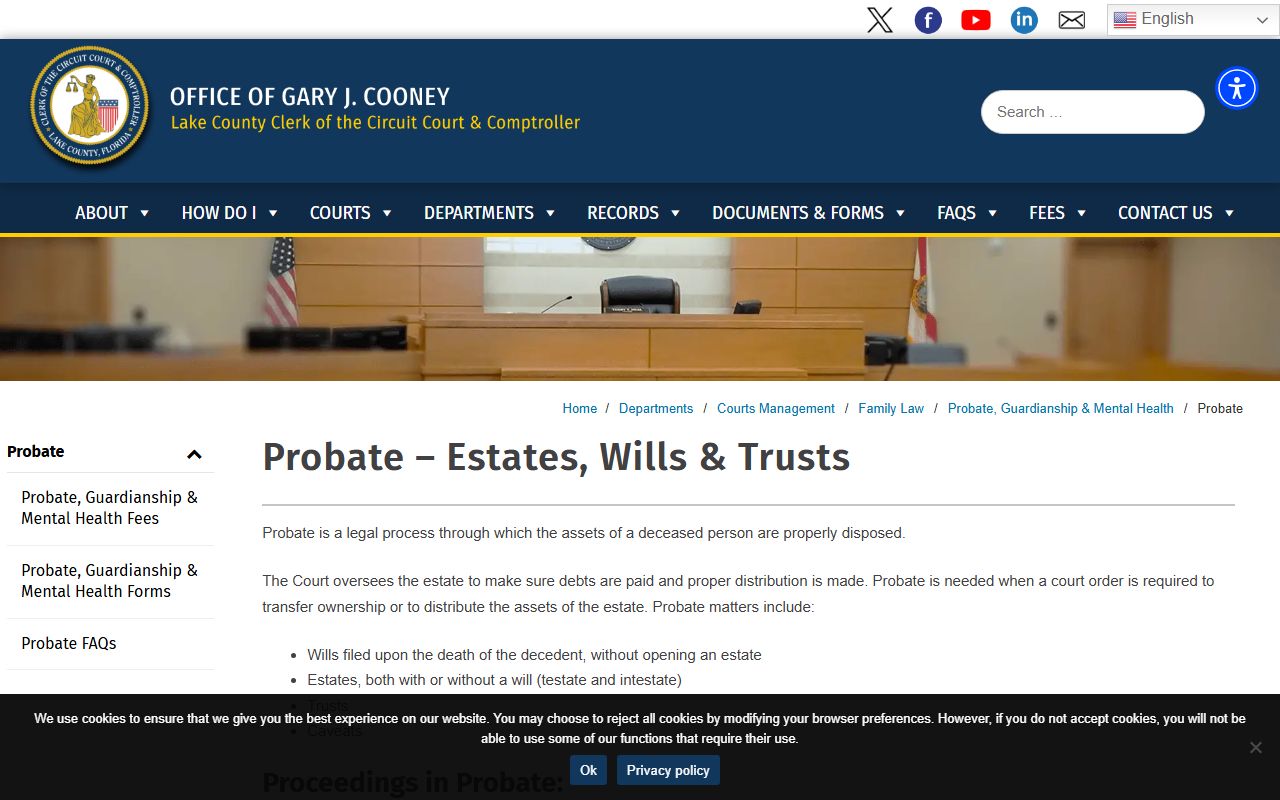
The probate page links out to local forms, the fee schedule, and FAQs.
- Open the ShowCase portal in a browser.
- Select Court Type Probate/Guardianship or Guardianship as needed.
- Type the decedent or ward name, or the case number.
- Filter by case status, judge, or filing date.
- Open the docket to view filings and orders.
- Order a certified copy from the Clerk if needed.
Document images may not always be visible online. Florida confidentiality rules limit some image access, so users may need to request and pay for copies through the Clerk. See the Clerk's probate FAQs page for common user questions.
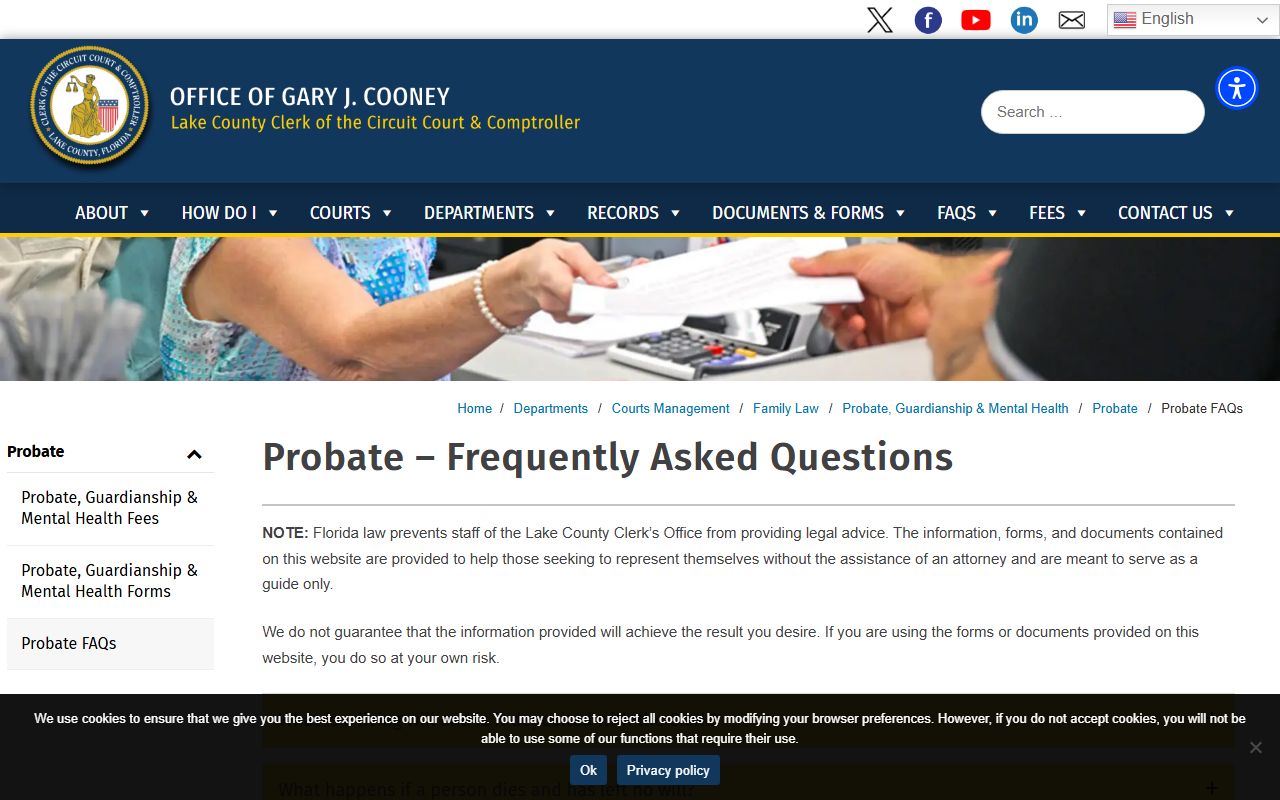
The FAQ page lists the documents Lake County asks for at intake and is the fastest way to confirm filing steps.
The Probate Division of the Circuit Court
Probate in Lake County is heard in the Probate Division of the Circuit Court. The Fifth Judicial Circuit covers Lake, Citrus, Hernando, Marion, and Sumter counties. The Probate Division is listed as a Lake County program on the official Fifth Judicial Circuit Lake page. Probate judges in Lake County rule on petitions, appoint personal representatives, supervise guardians, and close estates after final accountings are filed.
The Clerk side of probate sits inside the Family Law area of the courthouse. The Clerk groups Probate, Guardianship, and Mental Health into a single department. The probate counter handles filings, file checkout, and certified copies. Cases are filed in person, by mail, or through the state e-filing portal.
Clerk of the Circuit Court & Comptroller, Probate Office
Lake County Courthouse, East Wing
550 W. Main St.
Tavares, FL 32778
352-742-4100
Mon to Fri, 8:00 AM to 5:00 PM
Mail: PO Box 7800, Tavares, FL 32778-7800
The Clerk's office also runs the official records system, where wills filed for safekeeping prior to death may be deposited.
What Probate Covers in Lake County
Probate is the court process that handles a person's assets and debts after death. It also covers will contests, trust disputes, and the appointment of a personal representative. Florida uses several probate paths, and the right one depends on the size and shape of the estate. Small estates may qualify for summary administration. Larger estates use formal administration. Some very small estates may use disposition without administration.
Wills are deposited with the Clerk after a person's death. Florida law generally requires the original will to be filed within ten days. The Clerk indexes the will and links it to the probate case. Trust records may also pass through the Probate Division when a trust is contested or when court oversight is asked for.
Common matters in the Probate Division:
- Wills and estate administration.
- Trust litigation and trust accountings.
- Determination of heirs.
- Ancillary administration for out-of-state decedents who owned Florida property.
- Guardianship of adults and minors.
- Mental health petitions, including Baker Act and Marchman Act.
- Risk protection orders.
Guardianship in Lake County
The Probate Division also hears guardianship cases. A guardianship is a court process to give someone legal power to make decisions for a person who cannot do so alone. Florida courts handle guardianships for minors, adults with disabilities, and vulnerable adults. The court must find the ward lacks capacity before a full guardianship is set up. Lesser steps, such as a limited guardianship or advance directives, may be ordered when full guardianship is not needed.
Guardians must file an initial report, an annual plan, and an annual accounting. The Clerk reviews these filings and flags issues for the judge. The Clerk's site has a dedicated Guardianship page along with a Vulnerable Adults section. The user-facing guardianship page is the best place for forms, deadlines, and fraud-reporting tools.
See the full Clerk guardianship page for live links to forms and FAQs.
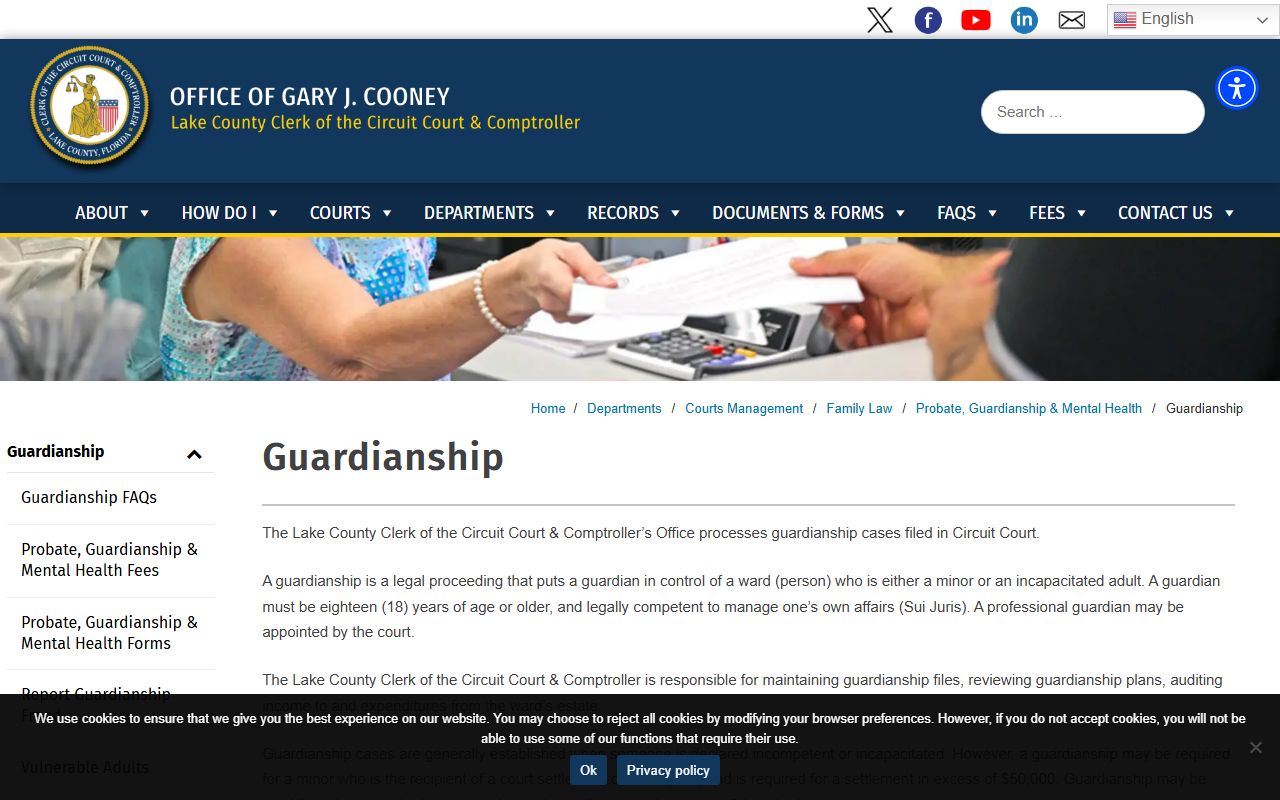
Lake County treats vulnerable-adult guardianship as a high-care area, with extra oversight from the Clerk and the Inspector General.
Note: Annual guardianship plans and accountings must be filed on time, or the judge may order the guardian to appear and explain the delay.
Mental Health Cases in Lake County
The Clerk groups Baker Act, Risk Protection Order, and Substance Abuse cases under Mental Health. These cases sit in the Probate Division because they involve civil court orders about a person's safety, care, or rights. Baker Act cases deal with short-term involuntary mental health holds and treatment orders. The Marchman Act covers substance abuse petitions. Risk protection orders, often called red flag orders, allow the court to bar a person from owning firearms when there is a real threat to self or others.
Most mental health filings are confidential under Florida law. Medical detail, treatment records, and patient identity are not posted online. The Clerk's site warns users that document images for these cases are limited. A relative or attorney with standing may request access through the Clerk by giving proof of role.
See the Clerk mental health page for current forms.
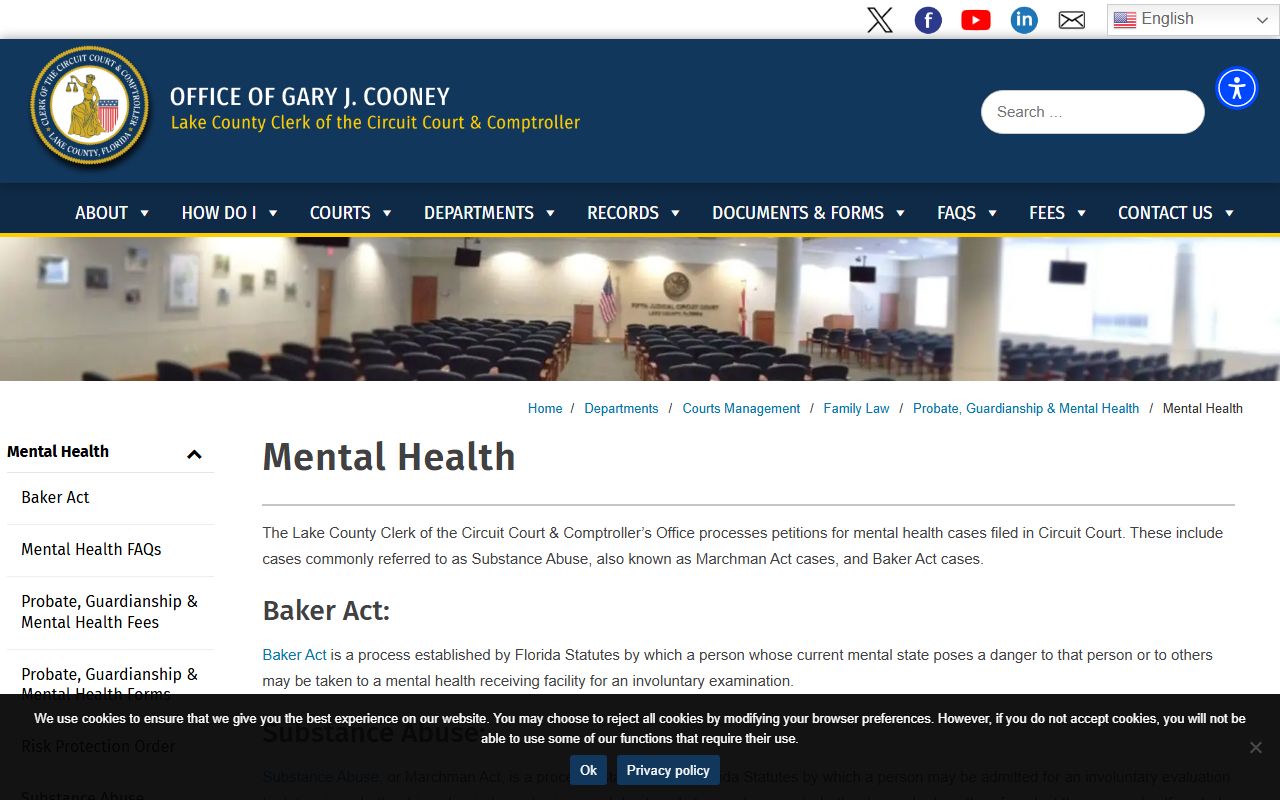
The page lays out Baker Act, Marchman Act, and Risk Protection Order info side by side, so a family member can find the right form fast.
Lake County Probate Workflow
Each probate case follows a similar path, though the steps shift slightly by estate type. Below is the standard workflow for a formal administration in Lake County. Summary administration and disposition without administration use a shorter list of steps.
- Decide whether the estate needs formal administration, summary administration, or disposition without administration.
- File the petition and supporting papers with the Clerk in the Lake County Courthouse.
- Deposit the original will with the Clerk if one exists.
- Pay the filing fee, or file the indigent application if the petitioner cannot pay.
- Wait for the order naming a personal representative or otherwise authorizing the estate.
- Publish notice to creditors and serve any required heirs.
- File the estate inventory and any accountings the judge orders.
- Pay valid claims, distribute remaining assets, and file receipts.
- File the petition for discharge and wait for the closing order.
Each step has its own filing window. Missing a deadline can stall the case. The Clerk's probate counter can confirm what is pending, but staff cannot give legal advice. A probate lawyer is often used for formal administration.
Common Probate Documents
Probate files in Lake County contain a mix of pleadings, sworn statements, financial papers, and court orders. The list of papers in any one case depends on the type of estate, but most files include the items below.
- Petition for administration and proposed order.
- Original will and any codicils.
- Certified copy of the death certificate.
- Oath of personal representative.
- Designation of resident agent and acceptance.
- Letters of administration issued by the Clerk.
- Notice to creditors and proof of publication.
- Inventory and any accountings.
- Petition for discharge and final receipts.
- Guardianship reports, plans, and accountings if a ward is involved.
Many of these papers are public, but some carry redacted fields. Social security numbers, account numbers, and minor children's data are masked under Florida court rules.
Probate Terms Defined
A small set of legal terms shows up in almost every probate case. The list below covers the words most users see when they pull a Lake County file or talk to the Clerk.
- Testator
- The person who made the will.
- Executor
- Older term for the person named in the will to carry out its terms. Florida now uses personal representative.
- Personal Representative
- Florida's term for the person the court appoints to manage and close the estate.
- Intestate
- Dying without a valid will. Florida's intestate statute then decides who inherits.
- Decedent
- The person who died and whose estate is in probate.
- Guardianship
- A court order giving one person legal power to act for another who cannot act alone.
- Ward
- The person under guardianship.
- Conservator
- A person named to manage another's property. Florida often folds this role into guardianship of the property.
Lake County Probate Filing Fees
The Clerk posts a single fee schedule for Probate, Guardianship, and Mental Health filings. Fees are set by Florida Statute and updated by local rule. The table below lists common items. See the official fee page for the current and full list.
| Item | Status |
|---|---|
| Petition for formal administration | See official fee page |
| Petition for summary administration | See official fee page |
| Disposition without administration | See official fee page |
| Letters of administration issuance | See official fee page |
| Certified copy per page | See official fee page |
| Guardianship petition | See official fee page |
| Annual guardianship audit | See official fee page |
| Mental health petition | See official fee page |
The official fee list is on the Clerk site. Visit the Probate, Guardianship and Mental Health fees page for live amounts.
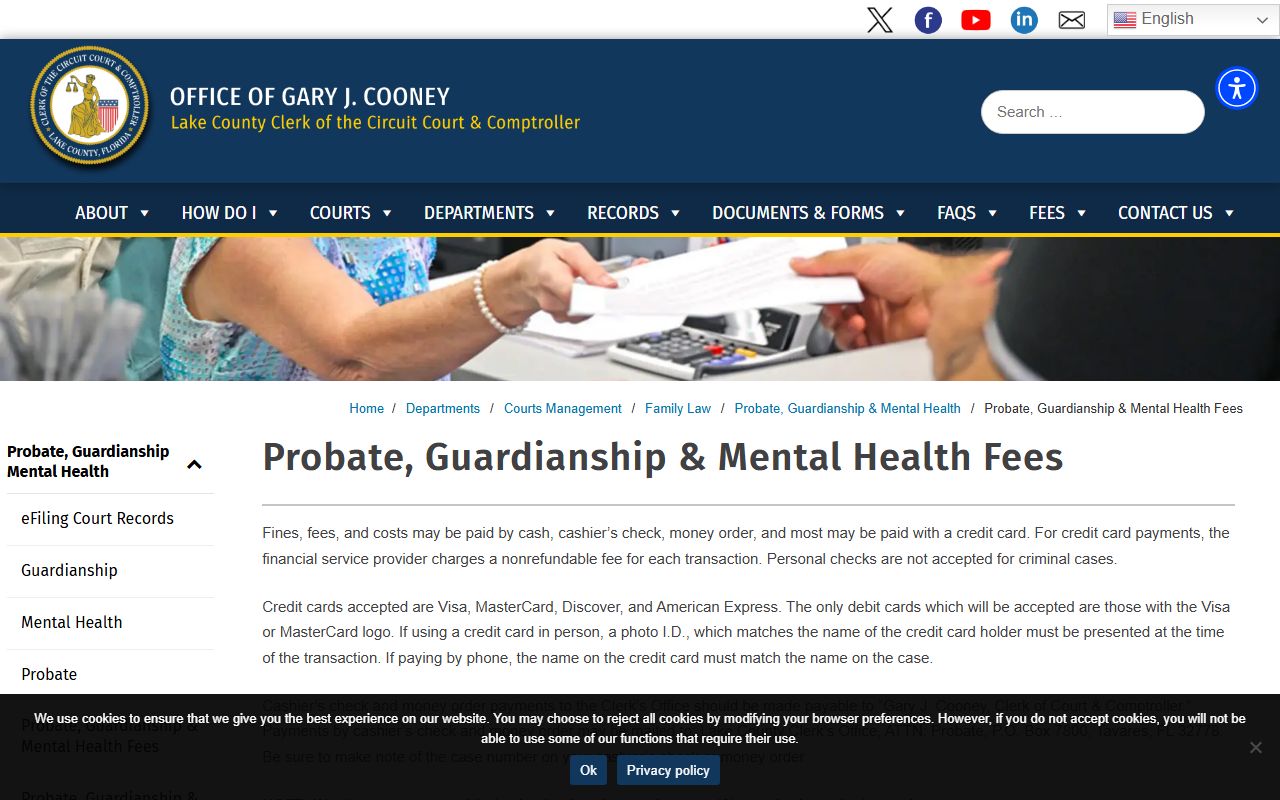
The fee page lists each item with its exact charge. Service charges are set in part by Fla. Stat. § 28.24, which covers the Clerk's service charges. Indigent filers can ask the court for a fee waiver.
Confidential Probate and Guardianship Records
Not every probate paper is open to the public. Florida court rules and several statutes lock down parts of probate, guardianship, and mental health files. The Clerk's ShowCase portal flags restricted cases with markers like sealed case and non-public case. The portal also masks Social Security numbers and driver license numbers from public results.
Key access rules come from Chapter 119 and Fla. Stat. § 119.0714, which set the public records baseline and the court file rules. Court access is further shaped by Florida Rule of General Practice and Judicial Administration 2.420. Mental health and Baker Act files have extra protections because they hold medical and treatment data.
Records that are commonly limited:
- Mental health and Baker Act files.
- Marchman Act substance abuse petitions.
- Guardianship of minors.
- Vulnerable adult details that touch on abuse claims.
- Adoption material, which is confidential under Fla. Stat. § 63.162.
- Social Security numbers, account numbers, and minors' personal data.
A person who has a right to see a restricted file can ask the Clerk to verify role and pull the file. The judge may also order release in a specific case.
Inspector General Guardianship Audits
Lake County's Clerk office runs more than passive record storage on the guardianship side. The Inspector General Department audits internal Clerk and county operations, reviews guardianship reports for issues, and looks into fraud, waste, and abuse claims made against the county. The Clerk also has a dedicated Report Guardianship Fraud page that any user can submit through.
This local oversight matters for two reasons. Families with concerns about a guardian's spending have a real place to report. Guardians also know the file is reviewed. Annual plans that look off can trigger an audit. Audits may lead to court action, removal of the guardian, or a referral to law enforcement in serious cases.
The Inspector General page on the Clerk site lists each audit category. Guardianship audits sit next to county operational audits and fraud reviews.