
How to Look Up Lake County Jail Population Data
Aggregate jail population data for Lake County is published by the Sheriff's Office, not the Clerk. The figures live on the LCSO Corrections Operations page at lcso.org Corrections Operations. That page lists facility capacity, average daily population, staffing, and accreditation status. The cadence is not a live feed. LCSO updates the page when it refreshes its public profile. For a true live count, the Sheriff would have to publish a daily roster total, which it does not.
For wider context, the U.S. Bureau of Justice Statistics at bjs.ojp.gov publishes annual jail population reports with county rates per 100,000 residents. The Vera Institute at vera.org aggregates similar data. None of these portals is a name search. Anyone who wants to find a specific person should use Lake County inmate records.
Note: The LCSO Corrections Operations page is the official anchor for Lake County jail capacity and ADP. Treat other sources as context only.
Lake County Detention Center Capacity Overview
The Lake County Detention Center is the sole county jail facility. It sits at 551 W. Main St. in Tavares, across from the Judicial Center. It was built in 1992. The official rated capacity is 960 inmates. LCSO reports an average daily population of 828. That puts the jail at about 86.25 percent of stated capacity at the time of the published LCSO overview. The facility holds men, women, and juveniles, and it accepts both misdemeanor and felony inmates.
The table below pulls the published figures from the Corrections Operations page. There is no satellite jail in Lake County. State prison inmates and federal detainees are not part of these counts.
| Facility | Address | Capacity | ADP | Notes |
|---|---|---|---|---|
| Lake County Detention Center | 551 W. Main St., Tavares, FL 32778 | 960 | 828 | Built 1992; men, women, juveniles; misdemeanor and felony. |
| State prison (FDC) | Statewide FDC facilities | Not local | Not local | Sentenced felony inmates only. Tracked separately. |
| Federal custody (BOP) | Federal BOP facilities | Not local | Not local | Federal cases only. Tracked by BOP. |
Average Daily Population
Average daily population, or ADP, is the mean number of people held in a jail across all days in a reporting window. LCSO reports an ADP of 828 on the Corrections Operations page. That number is a single anchor point from the agency. It is not a rolling daily average that updates each night. ADP smooths out booking spikes. A weekend booking surge or a holiday lull will not move the headline figure much.
A five-year ADP trend for Lake County was not located in extracted official sources at the time of this build. That is a research gap. LCSO annual reports and county budget documents may carry historical ADP data. For now, the anchor figure remains 828. The Sheriff also reported 9,169 bookings during 2019. Bookings are a flow figure. ADP is a stock figure. A jail with high turnover can have a modest ADP. A jail with long stays can show a smaller booking count and a higher ADP.
Misdemeanor vs Felony Holds
The Detention Center holds people on both misdemeanor and felony charges. LCSO does not publish a public percent split between the two charge classes on the Corrections Operations page. National data from BJS suggests that local jails across the country hold a mix of misdemeanor pretrial defendants, felony pretrial defendants, and sentenced misdemeanants serving short terms. Florida sentencing rules send most long felony sentences to the Florida Department of Corrections, so the felony share inside the county jail leans heavily toward pretrial cases and short county-jail sentences.
Lake County case numbers on ShowCase mark charge class in the case style. Cases coded CF are felonies. Cases coded MM are misdemeanors. Inferring an exact charge mix from court filings alone is risky because not every case carries a custody hold. A felony case can have a defendant out on bond. Anyone wanting a true mix needs LCSO booking data, not Clerk filing data.
Male, Female, and Juvenile Inmates
The Corrections Operations page states that the Detention Center holds male, female, and juvenile inmates. LCSO does not publish a public percent breakdown by sex or age on that page. National BJS data shows men make up the large majority of jail populations and women have been a slowly rising share. Juvenile holds inside an adult jail are usually short and tied to either secure detention transfer or to direct file cases under Florida juvenile statutes.
The framework table below shows what a full demographic breakdown would look like. Some rows are marked as data not published. That is intentional. Inventing precise local percentages would not match the source. Honest gaps beat fake precision.
| Group | Status |
|---|---|
| Male | Held; share not published by LCSO |
| Female | Held; share not published by LCSO |
| Juvenile | Held; share not published by LCSO |
| Race and ethnicity | Not published in the Corrections Operations overview |
| Age band | Not published in the Corrections Operations overview |
An image of the official LCSO Corrections Operations page is shown below. The source URL is lcso.org/bureaus/corrections_operations.
The screenshot captures the same headline figures used throughout this page: capacity of 960, ADP of 828, and the staffing and accreditation notes that anchor the local count.
Pretrial vs Sentenced Population
Most county jails hold two main groups: people held pretrial because they cannot post bond or are denied bond, and people serving short sentences after a guilty plea or verdict. LCSO does not publish a public Lake County pretrial-versus-sentenced split on the Corrections Operations page. That is a research gap for this county.
For national framing, BJS jail data has long shown that roughly two-thirds of the country's jail population is held pretrial, and roughly one-third is serving a sentence. The Vera Institute reports comparable shares for Florida. Treat those figures as context, not as a local Lake County percentage. A defendant in Lake County who is sentenced to a long felony term will move from the Detention Center into FDC custody. That movement keeps the jail roster weighted toward pretrial defendants and short-sentence inmates.
| Status | Lake County share | National framing (BJS) |
|---|---|---|
| Pretrial | Not published by LCSO | About two-thirds of local jail populations |
| Sentenced | Not published by LCSO | About one-third of local jail populations |
Bookings and Staffing
The Corrections Operations page says 9,169 inmates were booked into the Detention Center during 2019. Bookings count each intake event. The same person can be booked more than once in a year if they were arrested more than once. Bookings are not the same thing as unique people held. They are also not the same thing as ADP. A high booking count with a modest ADP usually means short stays and high turnover.
Staffing at the Detention Center stands at 239 personnel. That is 179 sworn corrections deputies and 60 non-sworn staff. The non-sworn group covers medical, food service, records, and support functions. The Detention Center contact line is 352-742-4006. The Sheriff's main jail line is 352-742-4000. Bond verification runs through 352-742-4024.
Accreditation and Medical Care
The Lake County Detention Center has been accredited by the Florida Corrections Accreditation Commission since 2006. The inmate medical department earned accreditation from the National Commission on Correctional Health Care in 2017. Accreditation is voluntary. It signals that an agency has met published standards in areas such as use of force, classification, mental health screening, medication, and grievance handling. It does not by itself measure outcomes.
The medical accreditation matters for population reporting because intake medical screening is a required standard. Every booked inmate gets a screening for acute medical and mental health needs. That result feeds housing assignment inside the jail and explains why caseloads are tracked as part of operations.
Note: Accreditation status is a structural marker, not a real-time quality metric. Verify current standing through FCAC and NCCHC if needed for research.
Jail vs State Prison Population
Lake County jail and Florida state prison are two different systems. The Detention Center is run by LCSO and holds people charged with a crime and people serving short county sentences. The Florida Department of Corrections runs state prisons and holds people sentenced to more than one year for a felony. Someone arrested in Lake County who is later sentenced to state prison will leave the LCSO roster and appear in FDC.
FDC's public inmate population search lives at FDC inmate population. The full FDC offender menu sits at FDC offender search menu. FDC refreshes its inmate population data weekly, with release dates and location changes updated nightly. FDC also states its databases do not contain people sentenced to county jail or county probation. Mixing FDC totals with LCSO totals produces a wrong number.
The FDC inmate population search is shown below. The source URL is pubapps.fdc.myflorida.com inmate population.
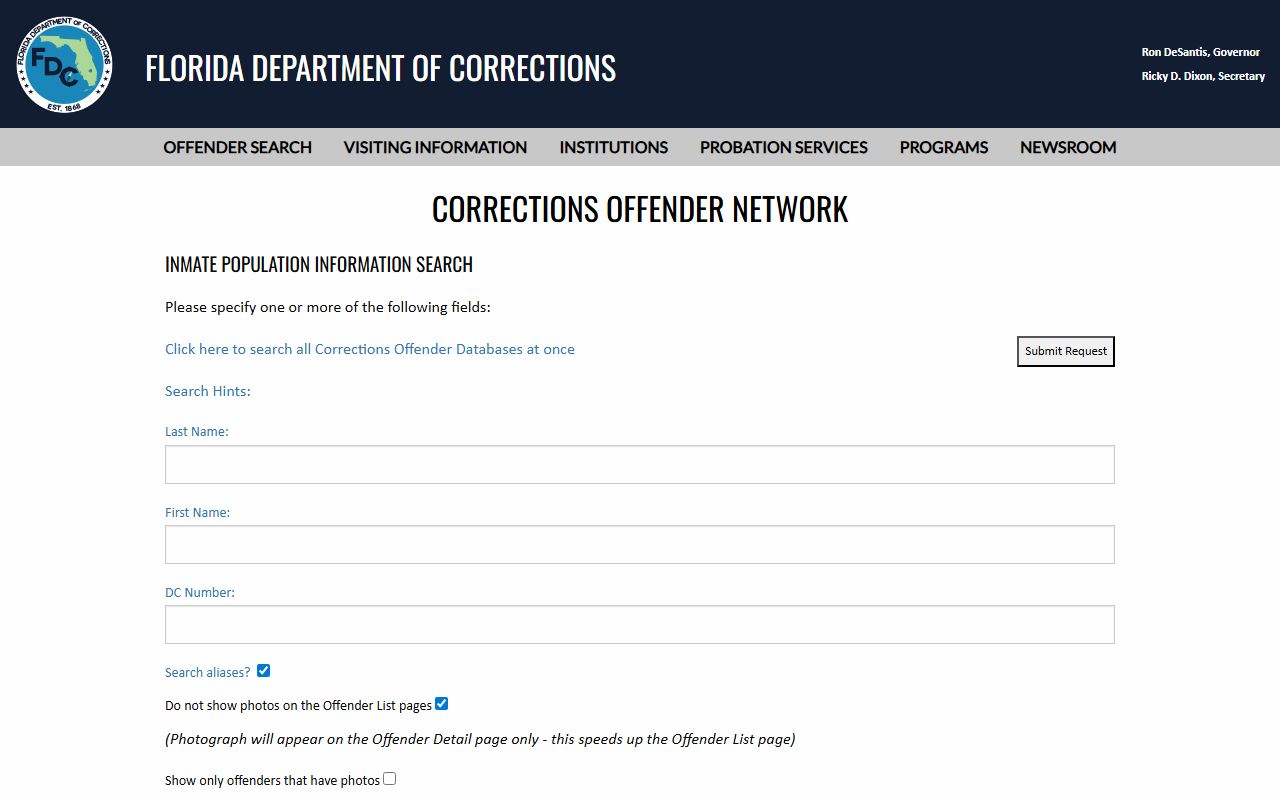
The FDC page is the right tool for state prison context, but it is not a Lake County jail tool. Use LCSO for local jail data and FDC for state prison data.
National and State Context
BJS and the Vera Institute publish jail population rates per 100,000 residents. Those rates let researchers compare counties of very different sizes. A small county with a small jail can still have a high rate. A large county with a large jail can still have a low rate. The Lake County rate per 100,000 is not anchored in the extracted LCSO research. Reporting a precise local rate without an authoritative cite would be invented. The table below frames what a full comparison looks like and marks the gap.
| Level | Jail population per 100,000 | Source |
|---|---|---|
| Lake County | Not cited in extracted sources | Research gap; BJS county profiles may carry this number |
| Florida statewide | See BJS jail report for the current year | bjs.ojp.gov |
| National | See BJS jail report for the current year | bjs.ojp.gov |
The Vera Institute's incarceration trends tool at vera.org publishes county trend lines and is a useful cross-check on BJS. When numbers diverge, the BJS series is the federal anchor.
Searching for Lake County Inmate Records by Name
This page covers aggregate Lake County jail population data. It is not a name-based lookup. The live LCSO roster is search-by-name only and lives behind a public form. For an individual lookup, use Lake County inmate records. For a person who has already been released, see released inmates. For an outstanding warrant rather than a current jail hold, see warrant records.
Where the Data Comes From
The local figures on this page come from the Lake County Sheriff's Office Corrections Operations page at lcso.org/bureaus/corrections_operations. That source provides capacity, ADP, 2019 booking count, staffing, and accreditation. The FDC inmate population data comes from pubapps.fdc.myflorida.com, refreshed weekly per the FDC notice. FDC's full offender search menu is at pubapps.fdc.myflorida.com inmate menu.
National framing comes from the U.S. Bureau of Justice Statistics at bjs.ojp.gov and the Vera Institute at vera.org. BJS publishes annual jail reports with a lag of one to two years. For common questions about how jail data, court data, and arrest data fit together, see the FAQ. The FDC offender search menu image below is from pubapps.fdc.myflorida.com inmate menu.
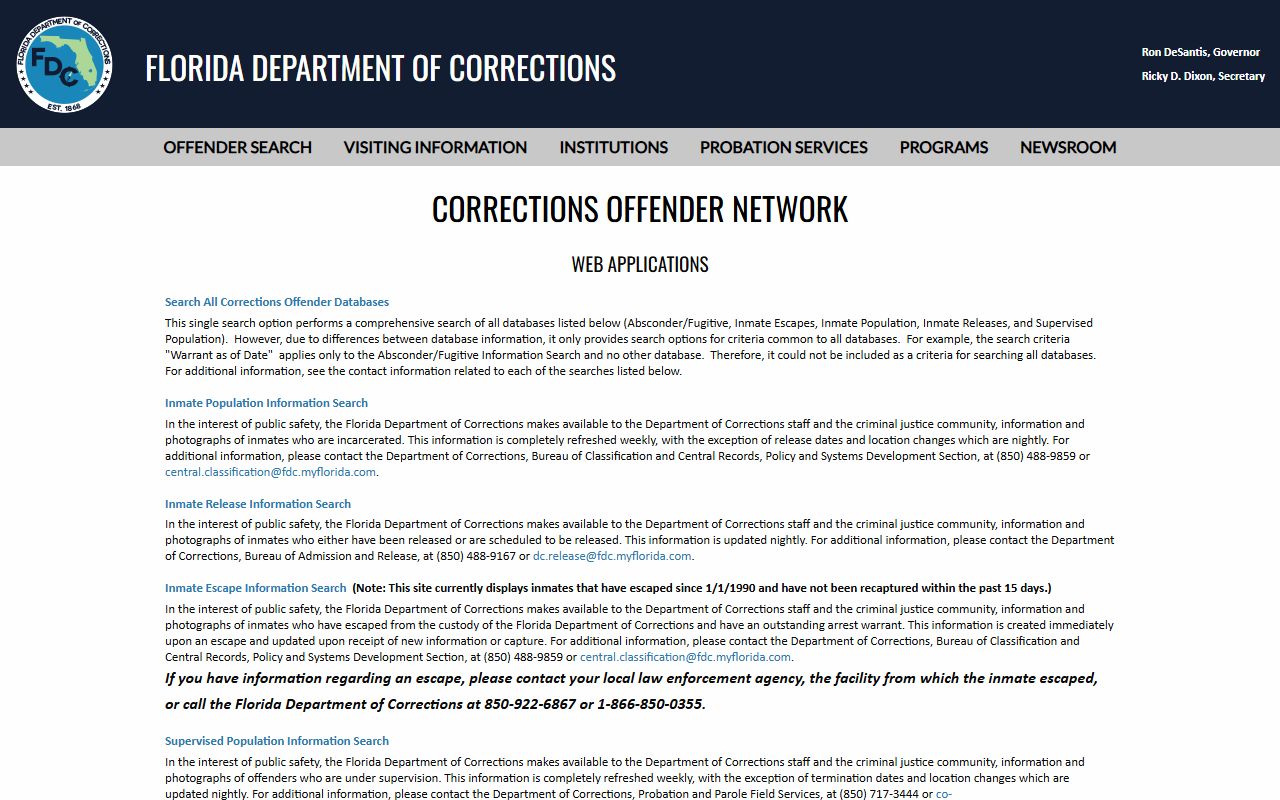
The FDC menu is the gateway to state prison data and supports the wider population context used above.