
Florida's Chapter 119 Public Records Framework
Florida's open records law lives in Chapter 119 of the Florida Statutes. Article I, section 24 of the Florida Constitution also locks in a public right of access. The rule is simple. Most records made or received by a state or local agency are open. The custodian must let any person see them or get copies at a set fee. The custodian may withhold a record only when a statute or court rule says so. Lake County agencies follow the same baseline. Florida courts have read the law in favor of access for decades.
The right to look at and copy nonexempt records is laid out in section 119.07. That statute also sets the path for fees, inspection in person, and how a custodian must explain any claimed exemption. A requester does not have to give a reason or show ID for most files. The law applies to paper, images, audio, video, email, and database extracts. Agencies must respond in a reasonable time and in good faith.
You can view the chapter on the state Senate site at flsenate.gov. The screenshot below points to the official text.
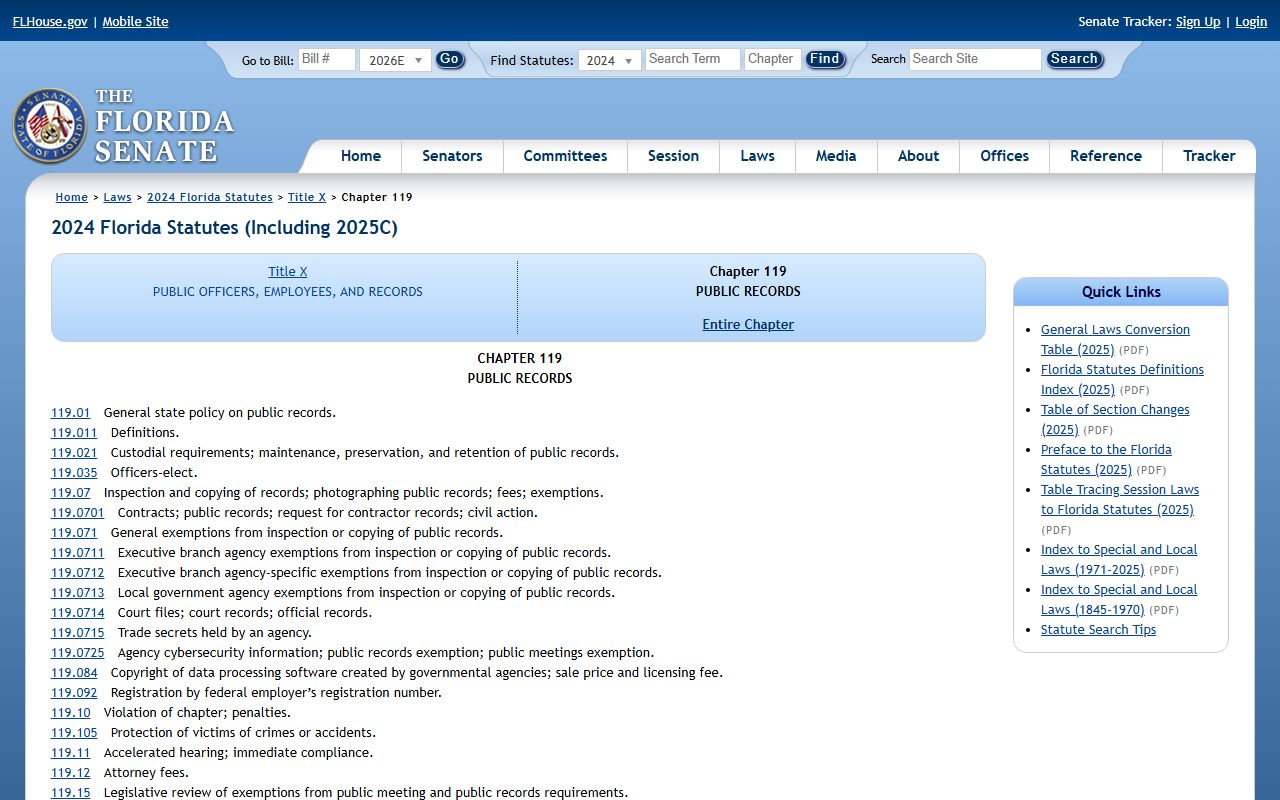
The chapter sets the floor for every records office. Lake County builds its day-to-day request process on top of it.
Note: Chapter 119 is the baseline. Court files also fall under a separate court rule that adds its own access and confidentiality steps.
Three Record Families in Lake County
Lake County records split into three groups. Each lives in a different system. Mixing them up is the top reason a search comes up empty. Pick the right family before you start. Court records hold case files. Official records hold recorded instruments like deeds. Administrative records hold board minutes, budgets, and contracts.
| Family | What It Holds | Where to Search |
|---|---|---|
| Court Records | Civil, criminal, family, probate, and traffic case files | ShowCase court records portal |
| Official Records | Deeds, mortgages, liens, marriage licenses after recording, tax deeds | Acclaim official records portal |
| Administrative Records | Board of County Commissioners files, finance, audit, contracts | Clerk public records request |
The Clerk of the Circuit Court and Comptroller, currently Gary J. Cooney, runs all three. The court side sits under Courts Management. The recorded side sits under Records and Administrative Services. Board and finance work sits under the Comptroller side. One office, three lanes.
Search Lake County Court Records Online
The fastest way to look up a court case is the Clerk's ShowCase court records portal. It is free and open to the public. No login is needed for basic search. A case number search uses the format like 35-2026-CF-000553-AXXX-01, where CF is felony, MM is misdemeanor, and TR is traffic. You can also search by last name, first name, judge, or case status. The portal lists civil, criminal, family, probate, and traffic court types.
Court file images are not always shown right away. Cases before 2003 often lack images. Criminal traffic has no images before 2009. Civil traffic has no images before 2013. Confidentiality rules also limit what shows up. Many documents are only released after staff redact protected data. For a deeper walk-through of the portal and case types, see Lake County court records and court dockets.
Search Lake County Official Records on Acclaim
Recorded instruments live in a separate site called Acclaim. The Clerk's Official Records portal covers deeds, mortgages, liens, plats, notices of commencement, tax deeds, and marriage licenses after they are recorded. The recording authority comes from section 28.222 of the Florida Statutes. The portal menu lets you search by Name, Book and Page, Doc Type, Instrument Number, Legal Description, Consideration, Record Date, Simple Search, or Case Number.
Always try spelling variants on names. Old documents may have indexing quirks. The Clerk scans at 300 DPI under Florida Administrative Code rules, so images are clear. Sealed or expunged items will not show. Some pages may be blacked out as the law requires. The Clerk says the data is given as a public service and is not warranted as final. For deeper title work, a recorded land record may need follow-up with a title company. Marriage records also touch marriage and divorce records and probate items touch probate records.
File a Public Records Request With the Clerk
If a record is not online, or is held in the administrative file, you can file a public records request with the Clerk. The Clerk runs a simple intake page that walks you through it. You can also call or mail the request. A clear, narrow request gets faster results than a broad one.
For an overview of the official intake page, see the screenshot from the Clerk's site.
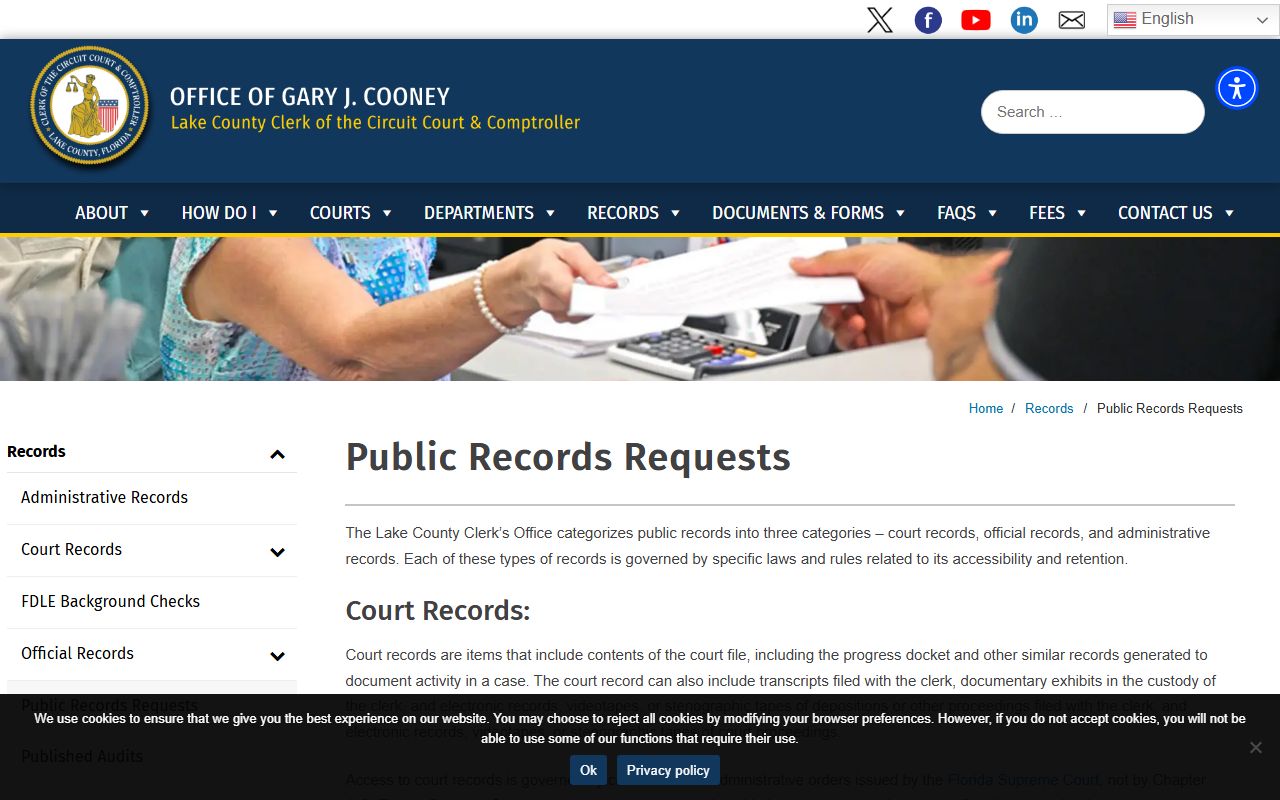
The Clerk's public records request page spells out the steps and the fees that may apply.
- Pick the right office. The Clerk holds court and recorded files. The Sheriff holds arrest reports. The county manager's office holds many board files.
- Describe the record. Give names, dates, case numbers, parcel IDs, or any other key that helps staff find the file.
- Pick a format. Paper copies, certified copies, or electronic copies are common. Some files are only on paper.
- Send the request. Use the online form on the Clerk's site, mail it to PO Box 7800, Tavares, FL 32778-7800, or hand it in at 550 W. Main Street in Tavares.
- Wait for a fee estimate. Larger requests get a written cost estimate. Small page-count requests may not.
- Pay and pick up. Pay by card, check, or in person. The Clerk will mail, email, or hand over the records when payment clears.
The state law does not set a strict day count for a response. Courts read section 119.07 to require a custodian to act in good faith and without unreasonable delay. Big or sensitive requests can take longer because staff must redact protected data.
Information a Requester Provides
The Clerk uses a short intake to capture what a requester needs. The Clerk also offers separate record search forms for some records. A complete intake lowers back-and-forth. The fields below are common across both routes.
| Field | Required | Notes |
|---|---|---|
| Requester Name | Yes | Helps staff route the answer and tag the file. |
| Contact Method | Yes | Email or phone, plus a mailing address if paper copies are wanted. |
| Record Description | Yes | Case number, party names, recording date, parcel, or topic of the file. |
| Date Range | No | Helps narrow a search when the exact date is not known. |
| Format | No | Paper, certified, PDF, or electronic. Some files come in one format only. |
| Delivery Method | No | Email, U.S. mail, in person pickup, or drop box at the courthouse. |
| Payment | Yes if fees apply | Card, check, money order, or in-person cash. Estimates given on larger jobs. |
The Clerk also has a record search forms page for routine lookups. Use that page first if a form fits your need. It often skips the longer request route.
Lake County Public Records Fees
Clerk service charges come from section 28.24 of the Florida Statutes. Section 119.07 also caps base copy charges and labor charges in special service requests. The Clerk lists current charges on its fee pages. Exact dollar amounts can shift, so the official pages are the source of truth. The table below points to those pages.
| Service | Amount | Source |
|---|---|---|
| Court data and records | See official fee page | Court data and records fees |
| County and circuit civil filings | See official fee page | Civil fees |
| Criminal filings and copies | See official fee page | Criminal fees |
| Domestic relations | See official fee page | Domestic relations fees |
| Probate, guardianship, mental health | See official fee page | Probate fees |
| Official records recording | See official fee page | Recording fees |
| Traffic | See official fee page | Traffic fees |
Section 119.07 allows a special service charge when a request takes a lot of staff time. The custodian must show that the work is extensive. Routine page copies do not trigger that extra charge. Certified copies cost more than plain copies because staff stamp and sign each one.
Exemptions and Redactions Under Florida Law
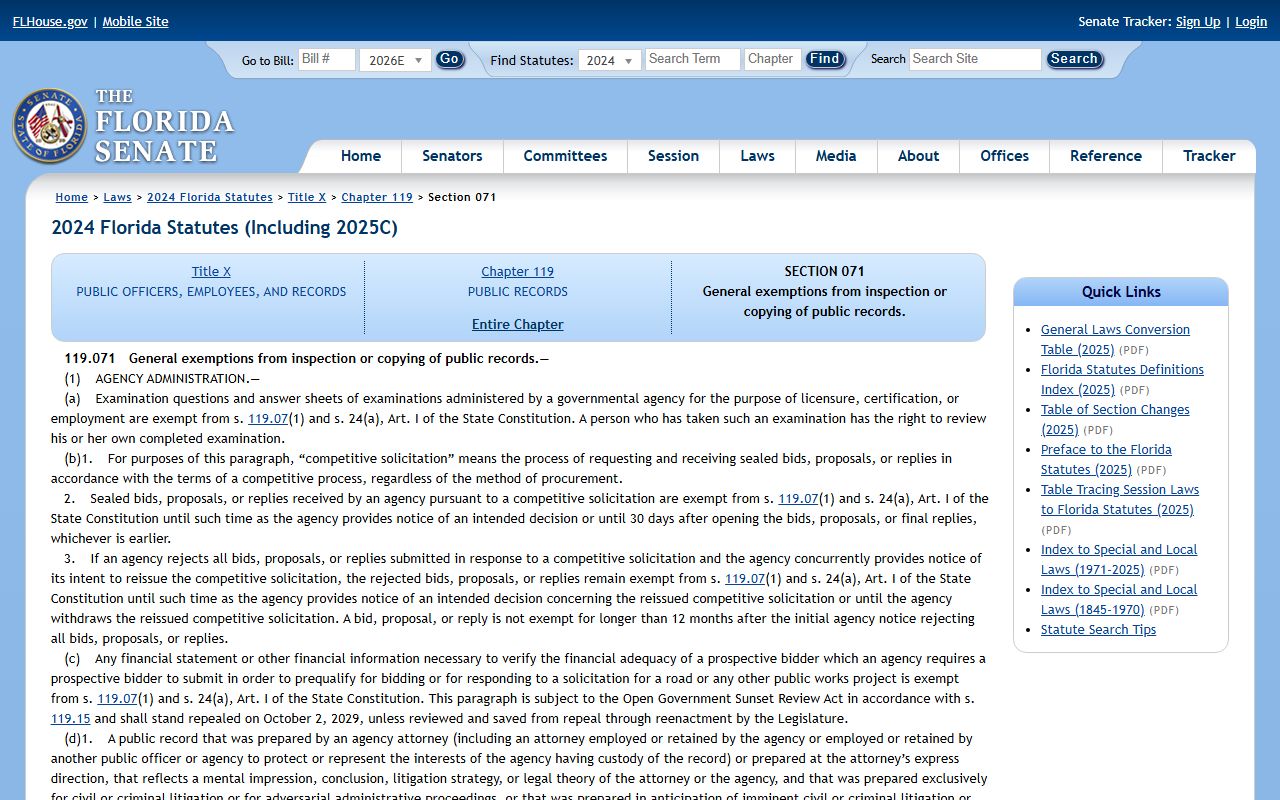
Not every public record is open. Florida law shields some files in full and some in part. The main list of carve-outs lives in section 119.071. It covers personal identifying data, active investigations, security plans, and protected job classes such as judges, prosecutors, and police officers. The Clerk also masks Social Security numbers and driver license numbers in public search results.
The screenshot below points to the official text of section 119.071.
Court files have a more focused rule at section 119.0714. That section sets which items in a court file or recorded official record must be redacted on request, and which items are confidential by law. Examples include sealed records, juvenile cases under section 985.04, and adoption files under section 63.162. The ShowCase portal uses internal flags such as isSealedCase, isExpungedCase, isJuvenileCase, and isAdoptionCase to lock those files from public view.
Section 119.0714 also lists specific data that must be redacted on written request. That list includes bank account numbers, charge card numbers, and other items the law protects. A requester can ask the Clerk to remove protected data from a public record under that section.
Board and Administrative Records
The Clerk also serves as Comptroller and clerk to the Board of County Commissioners. That means board meeting minutes, finance reports, internal audit reports, and inspector general files run through the Clerk's administrative side. Contracts, purchase orders, and travel records are often kept by the Board's own staff at the county administrative office. A request can go to either office. Staff route the request to the right custodian if it lands at the wrong door.
Board records do not run on ShowCase or Acclaim. A written request is the normal path. The Clerk's Records and Administrative Services Department handles many of these. The Comptroller side also holds the county's check register, accounts payable data, and grant reports. Big finance pulls may take longer because staff often run an export and then review the file for any exempt fields.
Note: A board record request can include emails. Florida treats agency email about public business as a public record subject to the same Chapter 119 rules.
Rule 2.420 and Court Record Access
Court files in Lake County also follow a court rule, not just the statute. The rule is Florida Rule of General Practice and Judicial Administration 2.420. It defines what a court record is, what a judicial branch administrative record is, and how to ask the court to seal or unseal a record. The rule also sets out how a filer flags confidential data in a filing.
The rule applies to all court records held by the Clerk for the Fifth Judicial Circuit, which covers Lake, Citrus, Hernando, Marion, and Sumter Counties. The Clerk follows Supreme Court administrative orders on online access. That is why some case images appear online while others must be requested in person or by written request.
The PDF spells out the steps a party uses to ask the court to keep a filing confidential. The full text is on the Florida courts site.
Skip Third-Party Aggregator Sites
A lot of search results lead to private data sites. They scrape public files, mix in old data, and charge a fee. Those sites are not the Clerk and are not the court. Data on them can be stale or wrong. They do not see sealed or expunged items the way the Clerk does, and they cannot certify a copy. Always start with the Clerk, the Sheriff, or the Fifth Circuit page when you need a Lake County file.
Free, official options cover most needs. The Clerk's ShowCase, Acclaim, and request pages are first stops. For deep court file detail, see court records. For Clerk office hours and branch addresses, see the Clerk of Court page. For common questions, see the FAQ.
Phone, Mail, Online, and Drop Box Options
The Clerk's Remote Services model lets a requester work without a courthouse visit. Online intake covers most record requests. Phone payments for eligible court fees and fines run at 352-742-3846 from 8:30 a.m. to 5 p.m., Monday through Friday. Visa, MasterCard, Discover, and American Express are accepted. Debit cards must have a Visa or MasterCard logo. The cardholder name must match the case.
Mail requests go to PO Box 7800, Tavares, FL 32778-7800. Walk-in service is at 550 W. Main Street in Tavares from 8:30 a.m. to 5 p.m. on weekdays. Drop boxes at the courthouse accept paper filings outside of staffed hours. The North Lake branch at 902 Avenida Central in The Villages of Lady Lake and the South Lake branch at 290 Citrus Tower Boulevard, Suite 116, in Clermont also accept many requests. Those branches focus on marriage and passport service and do not run full court case work.
For users who prefer paper, the Clerk's record search forms page hosts the forms in PDF. The forms cover criminal history checks, court case copies, and similar pulls. For finance or board files, plain written requests work well. The main line is 352-742-4100.